
Automated colorimetric water analyzers come in two main families: discrete analyzers, which keep the reaction of each sample separate, and segmented flow analyzers, which move samples in a continuous stream separated by air bubbles. The choice does not depend on the brand. It depends on the number of samples per day, the number of parameters you must report, the standard methods you must use, the type of water sample, and the lowest concentration you need to detect. If you provide all of this information together when you request a quotation, you will get an offer that fits your work from the first round.
What types of automated water analyzers are there, and how do they differ?
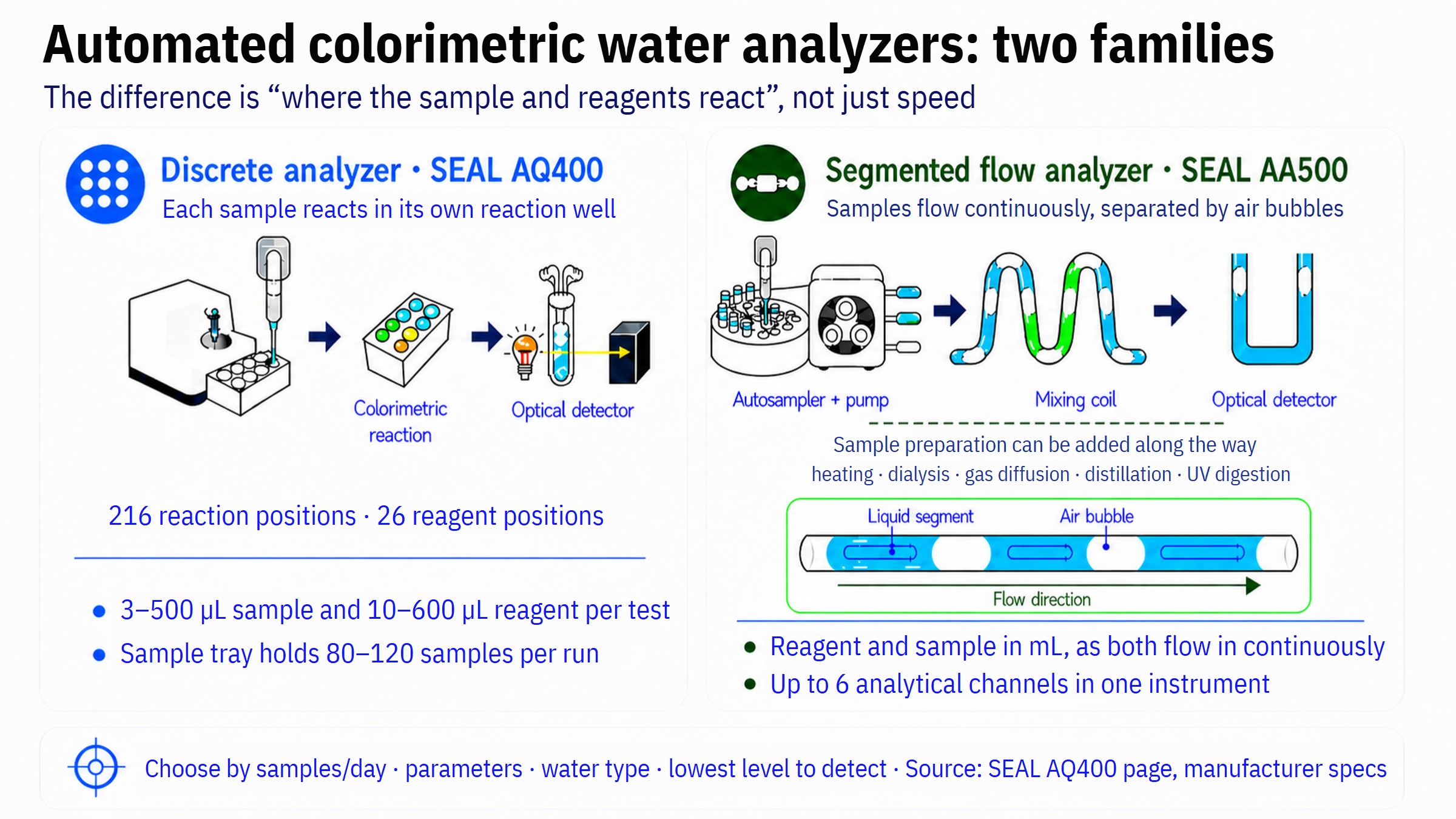
Automated water analyzers based on colorimetric analysis fall into two families. The difference is not only speed. It lies in how the sample and reagents react, which affects the volume of reagents used, the detection limit, and how flexibly you can switch between parameters.
A discrete analyzer keeps the reaction of each sample separate. Each test takes place in its own vessel, with no mixing. Its strengths are lower sample and reagent use per test and fast parameter switching without reconfiguring the system. This makes it a good fit for labs that must report many parameters but do not run very many samples per parameter, such as service labs that handle a wide range of work, or factory labs that monitor both the water they use and their wastewater.
A segmented flow analyzer lets reagents and samples flow into the instrument continuously, with air bubbles separating each segment to prevent carryover between samples. Because the reaction has time to go to completion, it stands out for low detection limits and accuracy in work that analyzes large numbers of samples repeatedly for the same parameters, such as seawater analysis or water quality monitoring where samples are collected from the same sites every month. The trade-off is that it uses larger volumes of reagents and samples than a discrete analyzer.
In short: if your situation is “many parameters, not many samples per parameter”, start by looking at a discrete analyzer. If it is “only a few parameters, but a very large number of samples and low values that must stay stable”, start by looking at a segmented flow analyzer.
| Comparison point | Discrete analyzer | Segmented flow analyzer |
|---|---|---|
| Reaction format | Each sample kept separate | Continuous flow, separated by air bubbles |
| Sample/reagent volume per test | Microliters (µL) | Milliliters (mL) |
| Sample preparation | Supports automated standard preparation, dilution, sample blanking and sample spiking | Supports automated standard preparation, dilution, sample blanking and sample spiking, and can perform inline preparation such as heating, dialysis, gas diffusion, distillation or UV digestion according to the standard method |
| Strengths | Wide range of parameters | Low detection limits; high sample numbers |
| Best suited to | Labs that need to measure many different parameters, such as service labs and factory labs that must report multiple values | Labs that need to measure large numbers of samples for the same parameters repeatedly, or samples that need inline preparation |
| Model supported by Thai Unique | SEAL AQ400 | SEAL AA500 |
5 things to include when you request a quotation
Quotations for water analyzers often need several revisions. This is not because suppliers are deliberately stalling. It is because the starting information is incomplete, so the specification has to be guessed first. If you provide these 5 items together from the first round, you will get offers that can genuinely be compared across suppliers.
1. Number of samples per day, and your busiest period
Not just the average. An instrument that fits a normal day may not keep up in months when clients send in samples all at once. The most useful figures are “how many samples on a normal day, and how many on the busiest day”.
2. Parameters you must report
List them all: those you run now and those you expect to add in the next 2-3 years. The number of parameters determines both the instrument model and the number of reagent positions required.
3. Standard methods you must use
This matters more than many people think. The notifications of the Thai authorities you report to often specify reference analytical methods as well, not just the limit values you must meet. Open the notification that applies to your business, check which methods it specifies, and include them in your request.
4. Type of water sample
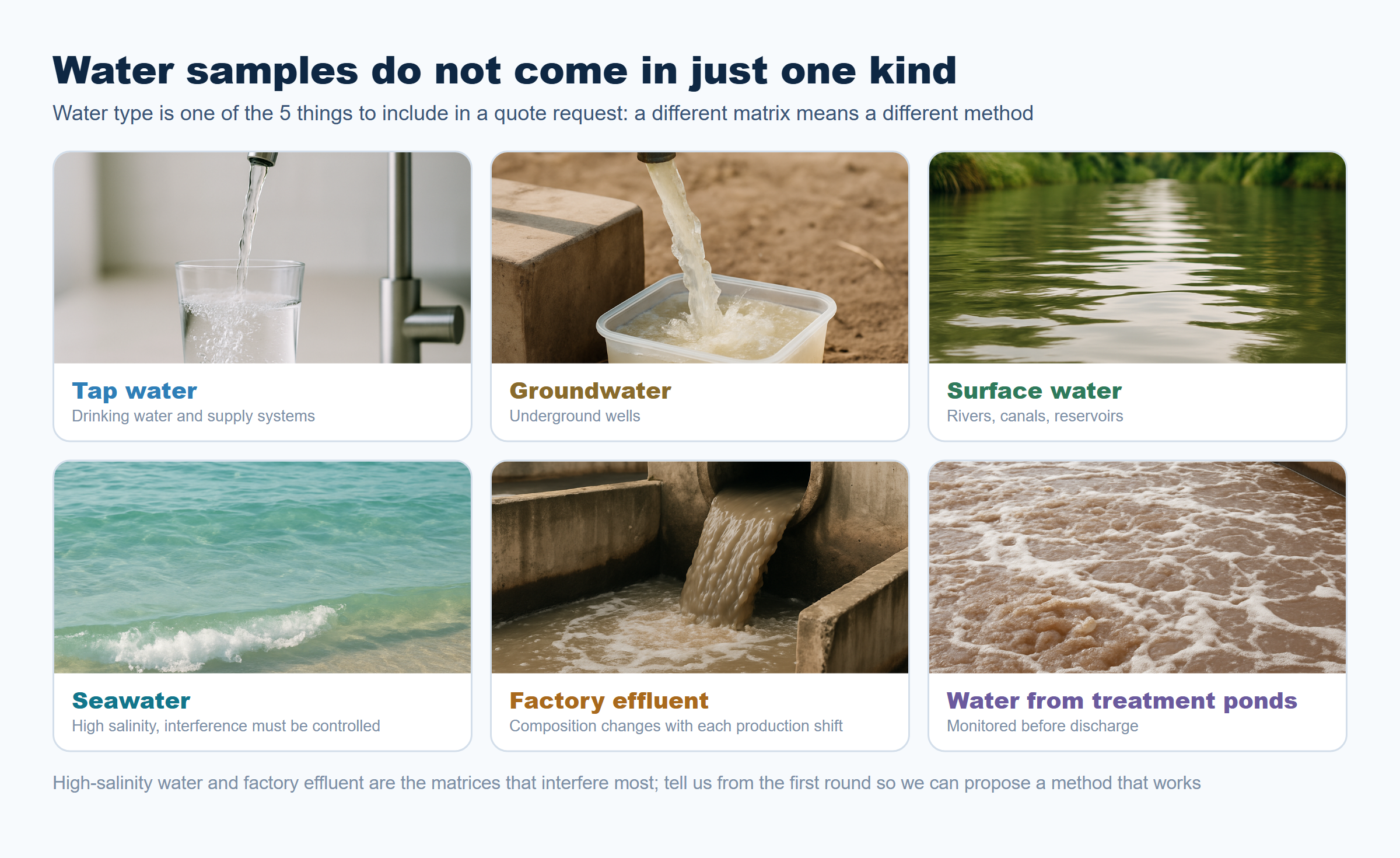
Tap water, groundwater, surface water, seawater, factory effluent and water from treatment ponds have very different matrices. Samples with high salinity or many interfering substances may need extra sample preparation steps, which affects both the equipment required and the time per run.
5. Lowest concentration you need to detect
If the limit you must report is very low, your options narrow immediately, and this may point to a segmented flow analyzer rather than a discrete analyzer. Give the value you actually need to report, not a standard limit that is easy to pass.
What makes prices differ
The same instrument model can be quoted at quite different prices, because a quotation covers more than the instrument itself. The factors with the greatest effect, in order, are:
- Number of parameters analyzed — each parameter needs its own reagent set and settings. The more values you report, the more sets you need to buy.
- Built-in digestion or distillation — work such as total nitrogen, total phosphorus or total cyanide needs a sample preparation step first. Having the instrument do this internally is convenient but costs more. Digesting separately in a block digestion system is more economical, but someone has to carry out that step.
- Number of reagent positions and refrigeration — some reagents must be kept cool to stay stable throughout the run. The number of refrigerated positions therefore determines how many parameters you can keep loaded without frequently swapping reagents.
- Sample tray capacity — a tray that holds more samples means the instrument can run unattended for longer without anyone refilling it, which is of direct value to labs that are short of staff.
- Service contract — whether it covers only annual calibration, or also includes consumable parts and repair visits when the instrument has a problem. This is the part that makes the numbers differ most over the long term, but it is often left out when prices are compared quickly.
A point to note when you compare quotations from several suppliers: compare on “can the same type of instrument do the same work?”, not on the final figure alone. A lower price may not include the digestion unit your work needs, or may provide fewer reagent positions, so that you have to swap reagents every day.
Ongoing costs people often forget
The instrument price is a single, one-time payment, but the cost that stays with the lab throughout the instrument’s working life is the ongoing cost. It should be assessed when you choose the instrument, not discovered once it is in use.
- Reagents — the largest share of ongoing costs, and a clear point of difference between discrete analyzers and segmented flow analyzers, because the volume used per test is not the same. If you run a heavy workload every day, this difference adds up to a significant amount within a single year.
- Pump tubes — a consumable that wears with use. Worn tubes cause errors in the volumes drawn and dispensed, which skews analytical results. Ask at the quotation stage how often they need replacing and where they can be bought.
- Light source lamp — as light intensity drops, the absorbance of both the samples and the calibration curve shifts together, noise increases, and the LOD and LOQ rise as a result. This may mean you can no longer report low values as you could before.
- Daily system running time — a cost that is not in the quotation but is real. An instrument that can start up and shut down automatically gives staff back time in the morning and evening for other work.
- Annual calibration and maintenance — ask from the start whether there is a team in the country that can do this work, and whether spare parts are ready to ship, because these two points determine how long the instrument will be out of service when there is a problem.
Specifications worth comparing
When you compare instruments, only a few figures truly affect day-to-day work. Below are the specifications of the two models Thai Unique supports, compared point by point and taken directly from the manufacturer’s technical documentation.
| Item | SEAL AQ400 (discrete analyzer) | SEAL AA500 (segmented flow analyzer) |
|---|---|---|
| Analytical principle | Discrete colorimetric — each sample reacts in its own reaction well, with no mixing | Segmented flow (SFA) — sample and reagents flow continuously, separated by air bubbles; the reaction goes to completion before measurement |
| Sample volume per test | 3–500 microliters (µL), depending on the method | Milliliter (mL) range, because the system draws sample continuously throughout the measurement |
| Reagent volume per test | 10–600 microliters (µL), typically 300–400 µL | Milliliter (mL) range, because reagents flow into the system continuously, just like the sample |
| Multiple parameters in one instrument | 26 reagent positions; several parameters can stay loaded at the same time | Up to 6 analytical channels in one instrument, and a multi-test manifold changes parameters without changing hardware |
| Built-in automated sample preparation | Prepares standards, pre-dilutes as programmed, automatically re-dilutes when a value is out of range, and can read sample blanks and spike samples | Also prepares standards, dilutes, reads sample blanks and spikes samples, and can add inline preparation such as heating, dialysis, gas diffusion, distillation and UV digestion |
| Automatic start-up and shutdown | Software control of the light source lamp, with an End of Run function | Fully automatic start-up and shutdown, including switching the pump on and off, releasing the pump tube pressure plate (platen), and valve and reagent wash programs |
| Detection system | 10-position filter (wavelength 405–880 nm), with a quartz tungsten-halogen light source and a silicon photodiode detector | Dual beam detection system, with an LED lamp light source covering 250–880 nm and a silicon photodiode detector |
| Sample capacity per run | 80 – 120 samples per run | Sample racks in several sizes to suit your workload; samples can be added during a run |
| Supported reference methods | Standard Methods for the Examination of Water and Wastewater, USEPA, ASTM, ISO, AOAC and DIN | Standard Methods for the Examination of Water and Wastewater, USEPA, ASTM, ISO, AOAC and DIN |
Parameters we confirm can be run on the SEAL AQ400 in Thailand include alkalinity, ammonia, chloride, hexavalent chromium, color, cyanide, nitrate, nitrite, ortho-phosphate, silica, sulfate and total phosphate, among others.
For the SEAL AA500, the parameters customers in Thailand most often request quotations for are nitrate, nitrite, total cyanide, phenol, ammonia and total nitrogen.
If your work includes total nitrogen or total phosphorus that must be digested first, and you routinely process dozens of samples at a time, consider a block digestion system such as SEAL BD50 and BD28 as well. Calculated per number of samples per run, it is more cost-effective than having the analyzer digest samples internally.
After-sales support in Thailand
Even the analyzer with the best specifications can give wrong results if it is not installed correctly, not calibrated accurately, or operated by users who were never properly trained. This part should therefore be in the quotation from the start, not discussed later.
Just as important as the instrument price is who will calibrate it, and whether that person really knows the analytical methods you use. Automated water analyzers have many variables that must be adjusted for each sample type, so the person who sets them up needs to understand the chemistry of the method, not just the buttons on the screen.
Thai Unique’s team are PhD-level specialists based in Thailand. They support you all the way from helping choose the right analytical method for your sample type, through installation, calibration and training, to ongoing after-sales support, and more than 95% of on-site issues are resolved within the country.
Both families of automated water analyzers discussed in this article are available in Thailand through Thai Unique, with installation, calibration and after-sales support teams based in the country.
If you would like our team to look at your lab’s workflow before you decide, contact us: phone 0-2629-0191-6 or email customer.service@thaiunique.com
Frequently asked questions
How much does the SEAL AQ400 cost?
There is no single price, because each project has different specifications and accessories. The factors with the greatest effect are the parameters you must report, the number of samples per day, the standard methods you must use, and the service contract you choose. The fastest route is to send us your sample type, number of samples per day and the parameters you must report, and we will put together a configuration and a quotation that fit your work.
How do I choose between a discrete analyzer and a segmented flow analyzer?
In principle, a discrete analyzer uses less sample and reagent per test and switches parameters quickly, so it suits work with many different parameters but not many samples per parameter. A segmented flow analyzer lets reagents and samples flow into the instrument continuously so that the reaction goes to completion, so it stands out for low detection limits and accuracy in repetitive work with large numbers of samples, such as seawater or environmental monitoring. As a result, a segmented flow analyzer uses larger volumes of reagents and samples than a discrete analyzer.
Our samples arrive at very different concentrations. Do we have to dilute them ourselves?
You do not need to dilute every sample by hand. An instrument like the AQ400 can be programmed to pre-dilute, and it automatically re-dilutes when a value is out of range, without re-running the whole batch. This reduces both time and manual dilution errors.
How little sample and reagent does each test use?
The AQ400 uses between 3 and 500 microliters of sample and between 10 and 600 microliters of reagent per test, depending on the method. This matters a great deal when sample volume is limited, such as water from sites that are hard to sample, or samples that have already been through several preparation steps.
Are calibration and ongoing support available in Thailand?
Yes. Thai Unique covers everything from installation, calibration and training to ongoing after-sales support, with a team based in Thailand. Contact: phone 0-2629-0191-6 · customer.service@thaiunique.com