
Before we start, one point needs to be clear. The rules in this article are EU rules, not Thai law. Thailand does not yet have legal requirements on PFAS, as we wrote in our September article. What has changed is that Thai exporters shipping packaged goods to the EU market must comply with these rules from August 2026 onward, even though there are no requirements at home yet.
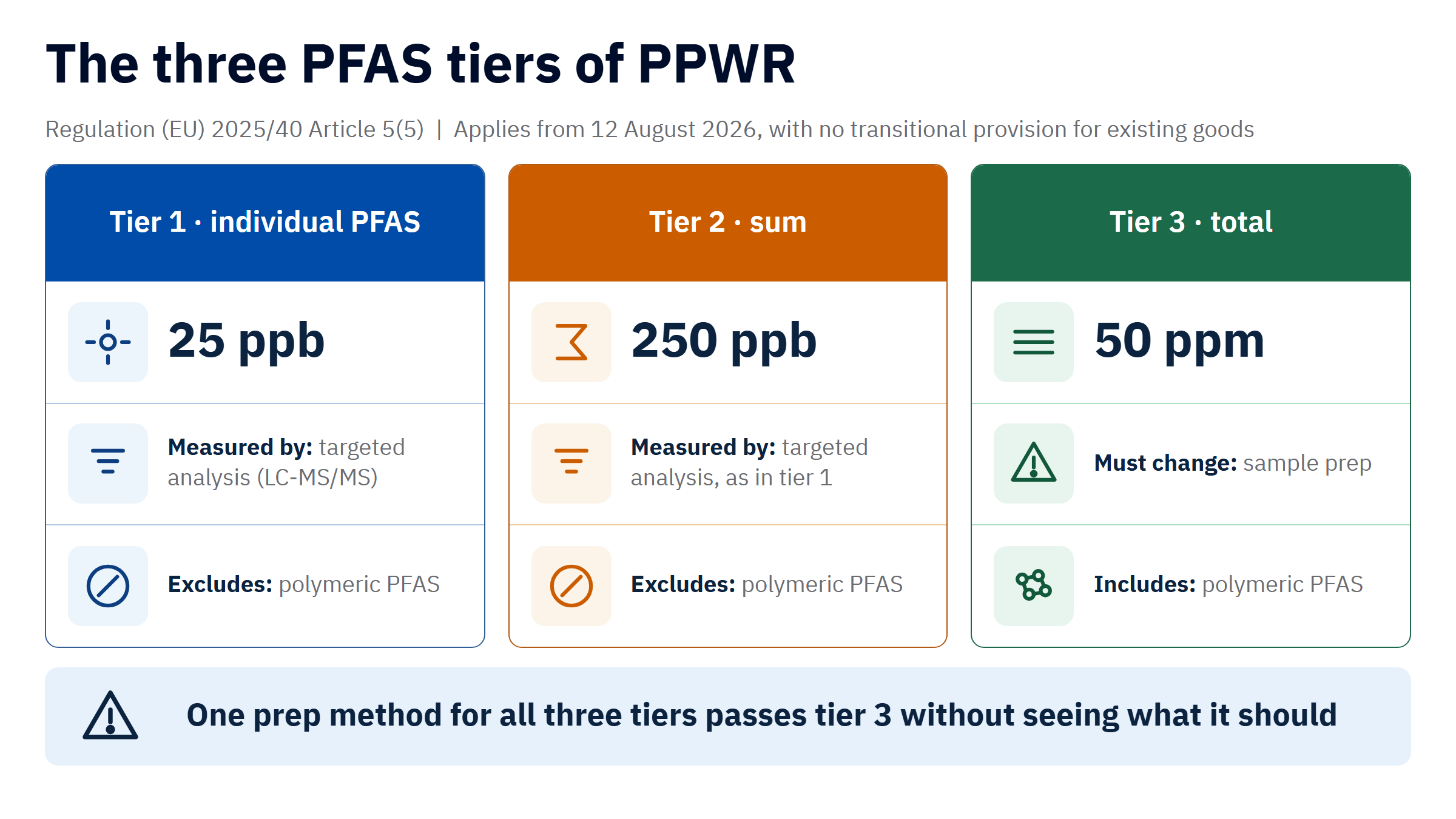
PPWR is Regulation (EU) 2025/40, the Packaging and Packaging Waste Regulation, which applies from 12 August 2026. The PFAS requirements for food-contact packaging are in Article 5(5) and are set in three tiers: 25 ppb for individual PFAS, 250 ppb for the sum measured by targeted analysis, and 50 ppm for total PFAS, including polymeric PFAS.
This article sets out to explain why these three tiers cannot all be measured with the same method. The reason lies in sample preparation, not in the analytical instrument.
What PPWR is, and why goods made before the deadline are not exempt
PPWR is the European Union regulation on packaging and packaging waste. It was published in February 2025 and applies from 12 August 2026. Read this point carefully: 12 August 2026 is the date the rules start to apply, not the publication date. The time between those two dates was the preparation period, and it has already passed.
What sets this regulation apart from others you may have dealt with is that there is no transitional provision for existing goods. Packaging made before August 2026 cannot be sold on the EU market if its PFAS levels exceed the limits. Existing stock is therefore not an exception.
In practice, for Thai exporters, this means the question has changed from “when do we need to start?” to “what are our levels right now?” That question has to be answered with analytical results, not with documents.
The three tiers in Article 5(5), and why each tier needs a different measurement
Tier one, 25 ppb, applies to any single PFAS. It is measured by targeted analysis and does not include polymeric PFAS.
Tier two, 250 ppb, applies to the sum of PFAS measured by targeted analysis, and also does not include polymeric PFAS.
Tier three, 50 ppm, applies to total PFAS, including polymeric PFAS.
The first two tiers are familiar to labs that already run PFAS work. Target compounds are measured one by one by LC-MS/MS, and both the individual values and the sum are reported. Tier three is a different job. PFAS bound to polymers will not show up in the extract if the extraction step does nothing to the polymer.
Put another way, if one sample preparation method is used to measure all three tiers, the result may pass tier three with a clean-looking number. That does not mean the item is actually clean. It means the method cannot see what it should see.
Another point is often confused. If total fluorine in packaging exceeds 50 mg/kg, the manufacturer must, on request, provide evidence of what proportion of the measured fluorine is PFAS. This does not mean the packaging fails as soon as the value is exceeded, and it is separate from the 50 ppm limit in tier three. Many secondary sources mix these two points up. If you quote figures, quote them directly from the text of Article 5(5).
Packaging is a different matrix from soil and tissue
The PFAS work Thai labs know best is water, soil and tissue, which we covered in article B-02 in September. This article covers a different matrix: the packaging itself.
A single food package is rarely one material. Coated paper, multilayer film, grease- and moisture-resistant coatings, printing inks and adhesives are all combined in one item. How much PFAS an item contains therefore depends on which layer is extracted and how much can actually be extracted from it.
A substance often found in this group is side-chain fluorinated polymer, used as a grease-resistant coating. Its structure is a polymer chain with fluorinated groups attached along the side. These substances are not released as free molecules if the sample is simply soaked in solvent.
Contamination control for equipment and consumables is important in every PFAS job, whatever the matrix, and we also covered it in our September article.
EN 17681-1:2025 and alkaline hydrolysis — extraction is the deciding step
EN 17681-1:2025 was published by CEN on 30 April 2025. Its full title is Textiles and textile products — Per- and polyfluoroalkyl substances (PFAS) — Part 1: Analysis of an alkaline extract using liquid chromatography and tandem mass spectrometry
To be clear from the start, this is a textile standard, not a packaging standard. Many labs adapt it for packaging because there is not yet a clearly specified sample preparation method for packaging, and the principle behind it matches the problem packaging presents.
The key difference is that the 2022 edition extracts with methanol, which only detects free PFAS. The 2025 edition switches to alkaline hydrolysis, which breaks down side-chain fluorinated polymers and releases the bound substances. As a result, the new edition detects polymer-bound PFAS and the old edition does not.
This is the whole reason why PPWR tier three, set at 50 ppm including polymeric PFAS, cannot be checked with a simple methanol extraction. The method you choose decides whether the figure reflects reality. It is not only a question of instrument sensitivity.
A point to watch: if a lab reports results citing only EN 17681-1, without stating the edition year, the recipient has no way to know whether the figure already covers the polymer-bound fraction. Stating the edition year is therefore not only a paperwork detail. It also changes what the result means.
How EPA Method 1633 and 1633A differ
The search term “epa 1633 vs 1633a” is one people really use, because many older documents still cite only 1633.
EPA 1633A is a revised version of EPA 1633. It keeps the same principles for PFAS analysis but incorporates error corrections and refinements to technical details, so the procedure is clearer and more standardized.
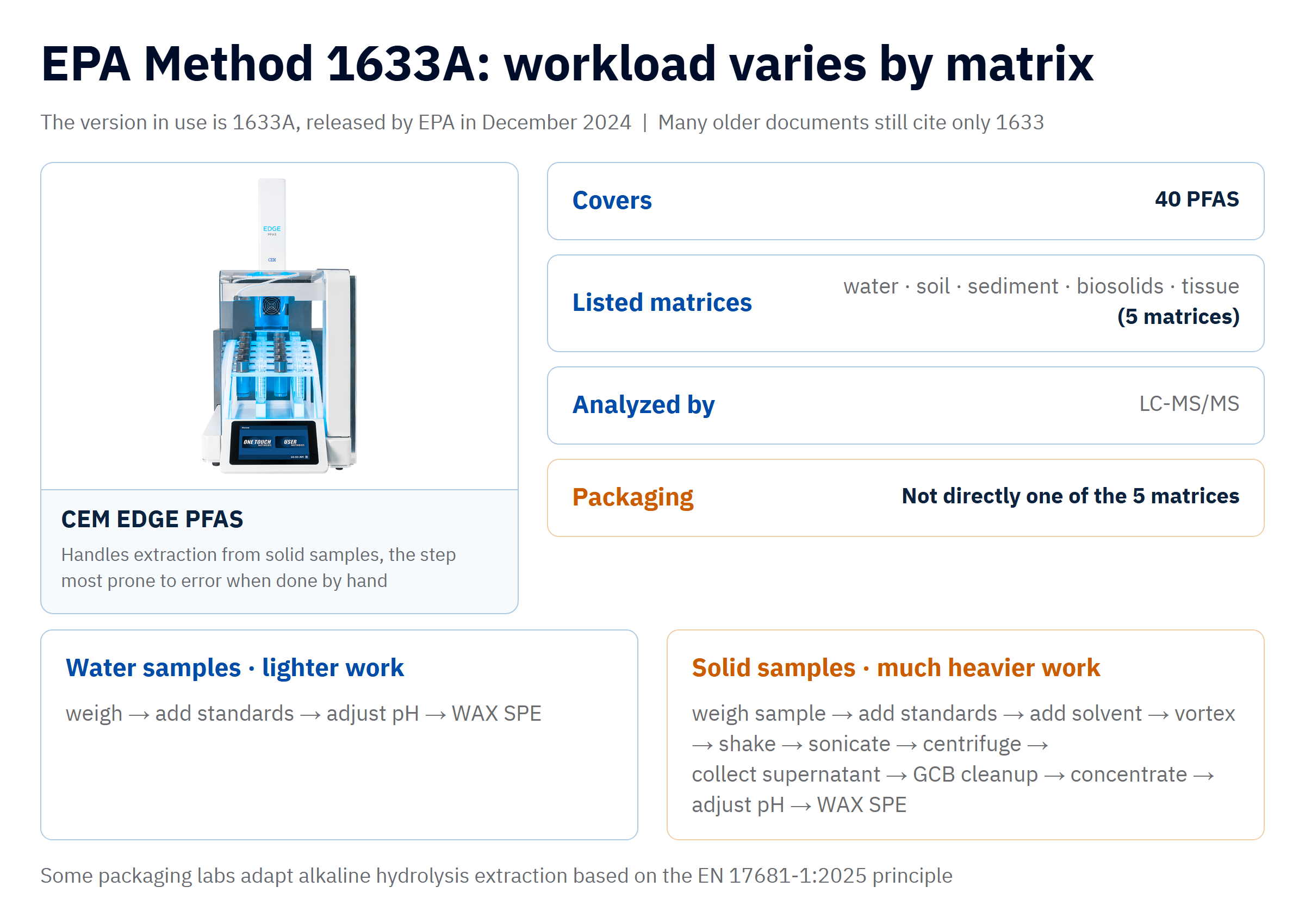
The version actually in use today is 1633A, which EPA released in December 2024. It covers 40 PFAS in water, soil, sediment, biosolids and tissue, analyzed by LC-MS/MS.
Under EPA 1633A, the difference that shows up most clearly in practice is the sample preparation each matrix needs. For water samples it is simply weigh, add standards, adjust the pH, then straight onto WAX SPE.
Solid samples start with weighing the sample, adding standards and adding solvent, then vortexing, shaking and sonication, then centrifugation to collect the supernatant for GCB cleanup, then concentration, pH adjustment and finally WAX SPE. This sequence has several points where things can go wrong if the preparation is all done by hand.
For packaging work, packaging itself is not directly on the 1633A matrix list. Some labs that take on packaging work adapt alkaline hydrolysis extraction based on the principle of EN 17681-1:2025.
Where automated SPE and concentrators matter if you need to reach ppb and ppt levels
Method 1633A does not require evaporation for water samples. In practice, however, labs often modify the SPE step to add evaporation in two cases: when a lower detection limit is needed, and when working with less than 1 milliliter of methanol.
When the target is at ppb and ppt level, both cases apply at the same time. The step that decides whether the analysis reaches the limit is therefore usually not the LC-MS/MS instrument, but the extraction and concentration steps before it.
The problem with doing these two steps by hand is consistency. Flow rates through the SPE column differ from sample to sample, and evaporation temperature and time are not controlled equally, so recovery swings from batch to batch. That is a major issue when the limits are at ppb and ppt level.
Systems that take over these three steps can be grouped by function. CEM EDGE PFAS handles extraction from solid samples, Detelogy iSPE-216/864 handles automated SPE for many samples at once, and Detelogy FV64/80UP handles concentration by nitrogen gas evaporation.
Before deciding, consider the number of samples per run you actually need to process, the matrices the system supports, and the connection to the results recording system you already use.
What to prepare besides the instrument, and support in Thailand
PFAS work has stricter requirements than general work for materials that touch the sample, which we covered in our September article. What packaging work adds is the procedure for preparing test portions: which part of the package to cut from, how to cut it without mixing layers, and what weight the results are reported against.
Another thing to agree with the downstream buyer from the start is the list of compounds to report. Targeted analysis can only report compounds on the list that has been set. If your list and the buyer’s list do not match, the results you send will not answer their question.
In Thailand, the bottleneck is usually not the instrument itself but consumables and spare parts that have to be ordered. We state this here so expectations are set correctly before any work is agreed.
Frequently asked questions
When does PPWR start to apply, and can goods made before then still be sold in the EU?
PPWR, or Regulation (EU) 2025/40, applies from 12 August 2026. It was published in February 2025, and there is no transitional provision for existing goods. Packaging made before that date cannot be sold on the EU market if its PFAS levels exceed the limits.
How do the 25 ppb, 250 ppb and 50 ppm limits differ?
All three values are in Article 5(5) of PPWR, for food-contact packaging. The 25 ppb limit applies to any single PFAS measured by targeted analysis, not including polymeric PFAS. The 250 ppb limit applies to the sum of PFAS measured by targeted analysis, also not including polymeric PFAS. The 50 ppm limit applies to total PFAS, including polymeric PFAS. This is the tier that needs a different kind of extraction before it can be measured.
Does Thailand have legal requirements on PFAS in packaging yet?
Not yet. PPWR is an EU rule, not Thai law. Thai businesses are affected when they ship packaged goods to the EU market, because those goods must meet these limits. Businesses that sell only in Thailand therefore have no legal requirement on this yet.
How do EPA Method 1633 and 1633A differ?
EPA 1633A is a revised version of EPA 1633. It keeps the same principles for PFAS analysis but incorporates error corrections and refinements to technical details, so the procedure is clearer and more standardized. If you need to cite it in a report, state clearly that it is version A.
Why use alkaline hydrolysis when EN 17681-1:2025 is a textile standard?
Because there is not yet a clearly specified sample preparation method for packaging, and the principle of the 2025 edition matches the problem packaging presents. Side-chain fluorinated polymers used as grease-resistant coatings do not release the bound substances if extracted with methanol as in the 2022 edition. Labs therefore adapt this principle, and the report should state clearly which method was used and which edition year is cited.
Does total fluorine above 50 mg/kg mean the packaging fails?
No. The requirement states that when total fluorine exceeds 50 mg/kg, the manufacturer must, on request, provide evidence of what proportion of the measured fluorine is PFAS. This is separate from the 50 ppm limit in tier three, which covers all PFAS. Many secondary sources mix these two points up.