
Coconut water exporters often hear the same question from buyers in their destination markets: how can you prove that a product labeled as having no added sugar really is what the label says? Sugar isotope testing of coconut water is how this question is answered.
The answer used internationally is carbon isotope ratio measurement. This data is difficult to falsify, and the results are straightforward to read.
There are two main types of isotope analyzer for this work: the traditional IRMS (isotope ratio mass spectrometry), and CM-CRDS from Picarro, which connects a combustion module to a carbon isotope analyzer. This article explains the principle, the reference values reported in research and how the two techniques differ.
Why carbon isotopes can show that sugar was added
Different groups of plants fix carbon through different photosynthetic processes. Each process leaves a signature in the ratio of carbon-13 to carbon-12 in the plant tissue.
Coconut is a C3 plant, which has a lower value for this ratio. Sugarcane and corn, the sources of cane sugar and corn syrup, are C4 plants, which have clearly higher values.
When sugar from C4 plants is added to coconut water, the average value of the sample shifts toward the C4 side in proportion to the amount added. This is what makes it detectable.
Reference values reported in research
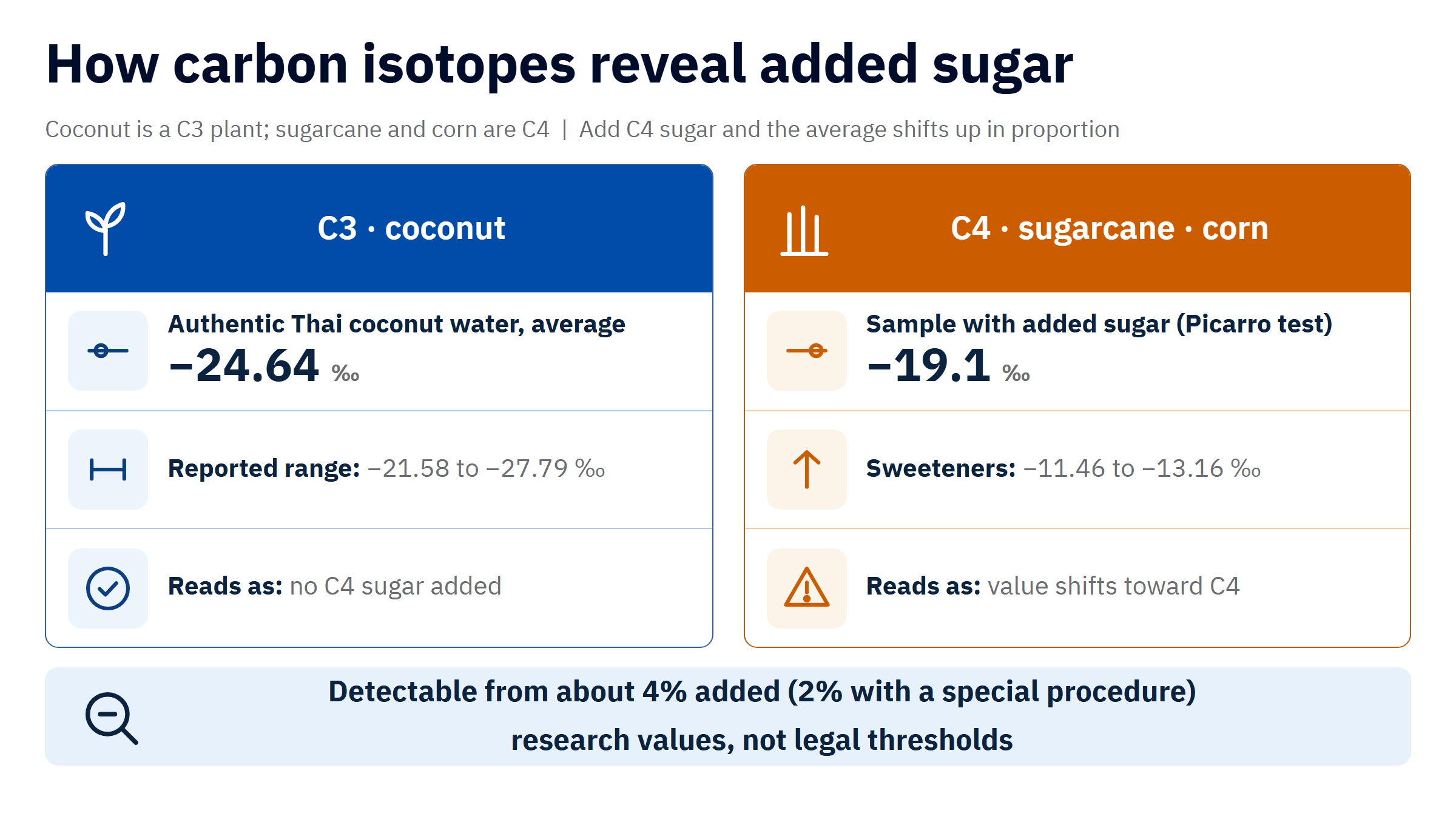
Authentic young coconut water from 94 samples across 12 Thai provinces has an average value of about -24.64 per mil, with a reported range of -21.58 to -27.79 per mil (in Thailand, commonly taken as -22 to -27).
When sugar is added, the value shifts up in proportion to the amount added. In a Picarro test, a sample in which about 40% of the sugar came from added fructose measured about -19.1 per mil, compared with about -25.4 per mil for a sample without added sugar.
Sweeteners derived from C4 plants fall in the range of -11.46 to -13.16 per mil (in Thailand, commonly taken as -10 to -12).
Added sugar can be detected from about 4% upward, and from about 2% with a special procedure.
These figures are values reported in research. They are not legal thresholds. In practice, you should also build your own database of raw material values from your own sources, because the ranges can vary with variety, growing area and season.
How the Picarro CM-CRDS isotope analyzer works
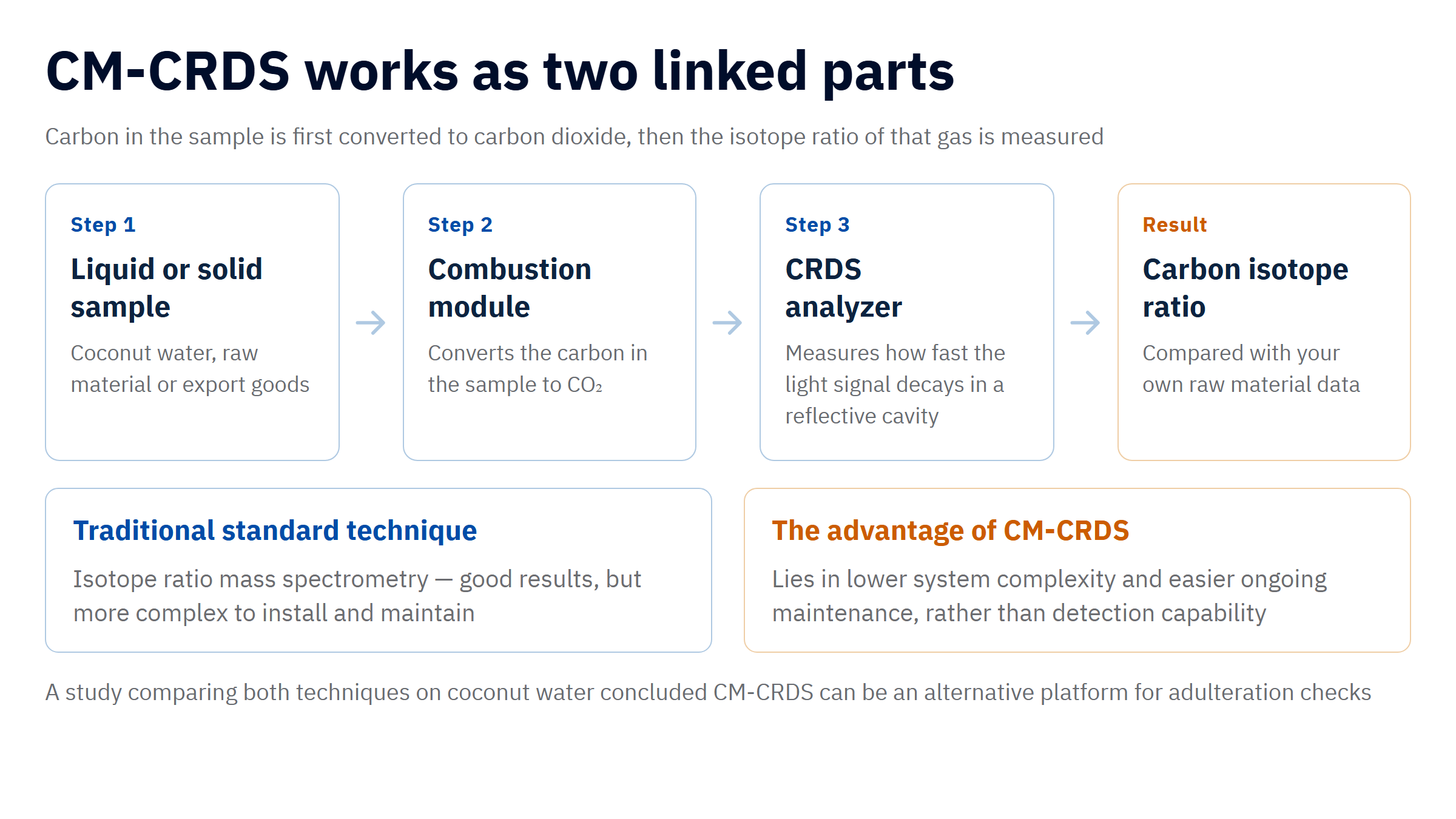
The system has two parts. The first is a combustion module (Picarro CM, model A0201), which converts the carbon in a liquid or solid sample into carbon dioxide.
The second is a CRDS carbon isotope analyzer such as the Picarro G2131-i, which measures the isotope ratio of the resulting carbon dioxide by measuring how fast a light signal decays inside a reflective cavity.
The traditional standard technique for this kind of work is isotope ratio mass spectrometry (IRMS). It gives good results, but it is more complex to install and maintain. A study by Mahidol University and the Thailand Institute of Nuclear Technology (TINT) measured young coconut water from 12 provinces across Thailand (94 samples), along with samples spiked with sweeteners, using both techniques. The values were not significantly different, and the study concluded that CM-CRDS can be used as an alternative platform to IRMS for detecting adulteration.
For a lab that wants to start work in this area, the clearest advantage is therefore lower system complexity and easier ongoing maintenance, rather than detection capability, because the system is designed to be easy both to operate and to maintain.
On cost, a Picarro application note states that CM-CRDS can lower total annual cost by up to 50% compared with EA-IRMS, including instrument depreciation, labor and consumables. This is the manufacturer’s estimate, and the actual cost depends on each lab’s sample volume and usage.
How exporters can use this data
The main benefit is not about catching anyone out. It is about having data that verifies your own products.
A practical approach is to record values for raw material from your supply sources in your own database, test products before export on a regular cycle, and keep the results as supporting evidence for when buyers in destination markets ask for it.
For factories that buy raw material from several sources, the same data can also be used to check incoming raw material. This prevents problems before they turn into disputes with end customers.
It also helps develop production formulas that fit customer requirements, improving accuracy and reducing production costs.
What to prepare if you test in your own lab
Reference materials with known isotope ratio values, for calibration and performance checks.
Consistent procedures for preparing and storing samples, because evaporation and changes during storage affect the measured values.
A database of raw material values from your own sources, which is essential for interpreting results.
A plan for calibration and scheduled maintenance.
If you would like our team to help assess how your lab should get started, send us the sample type and the number of samples you need to test each month. Contact us: Tel. 0-2629-0191-6 · customer.service@thaiunique.com
For the products related to this article, see the Picarro G2131-i and Picarro CM (A0201) pages.
The isotope analyzers mentioned in this article are available in Thailand through Thai Unique, with installation, calibration and after-sales support teams based in the country.
Frequently asked questions
What is the lowest level of added sugar that can be detected?
Added sugar can be detected from about 4% upward, and from about 2% with a special procedure. This depends on the quality of sample preparation and on the reference database used.
What range of values does authentic coconut water fall in?
Research on 94 Thai coconut water samples reported an average of about -24.64 per mil and a range of -21.58 to -27.79 per mil (in Thailand, commonly taken as -22 to -27), which is the normal range for C3 plants.
How does this differ from testing by IRMS?
Both techniques measure the same thing. The Mahidol University and TINT study that compared them on Thai coconut water found no significant difference in the values and concluded that CM-CRDS can be used as an alternative. The clearest difference is in system complexity and the ongoing maintenance workload.
How much does the cost differ from IRMS?
Picarro states that CM-CRDS can lower total annual cost by up to 50% compared with EA-IRMS, including instrument depreciation, labor and consumables. The actual figure depends on each lab’s sample volume and usage. Tell us your workload and we can help you estimate it.
Can this be used for products other than coconut water?
The same principle applies to other products whose main raw material is a C3 plant and that are at risk of having sugar from C4 plants added. Before applying it to a new product, first build a reference database for that product.
How should samples be prepared?
No sample preparation is needed; samples can be measured right away. The key is a consistent procedure at every stage, from collection and storage through to preparation before analysis. Evaporation or changes along the way directly affect the measured values.
Where can I buy a coconut water isotope analyzer in Thailand?
The core of a CM-CRDS system is the Picarro G2131-i carbon isotope analyzer connected to the A0201 combustion module. It is available in Thailand through Thai Unique, with installation, calibration and after-sales support teams based in the country. Send us the sample type and the number of samples you need to test, and we will put together a configuration that fits the work.