
Greenhouse gases are gases in the atmosphere that absorb and emit infrared radiation. This traps part of the heat instead of letting it dissipate.
For organizations that must report emission figures, the definition is only the start. The next question is how to get those figures: use default values that others have already calculated, or measure them yourself? And if you measure them yourself, what kind of instrument do you need?
This article covers which gases are involved, which ones work in Thailand actually deals with, the principles of the two most widely used measurement techniques, and how to choose the one that fits your work.
Which gases count as greenhouse gases
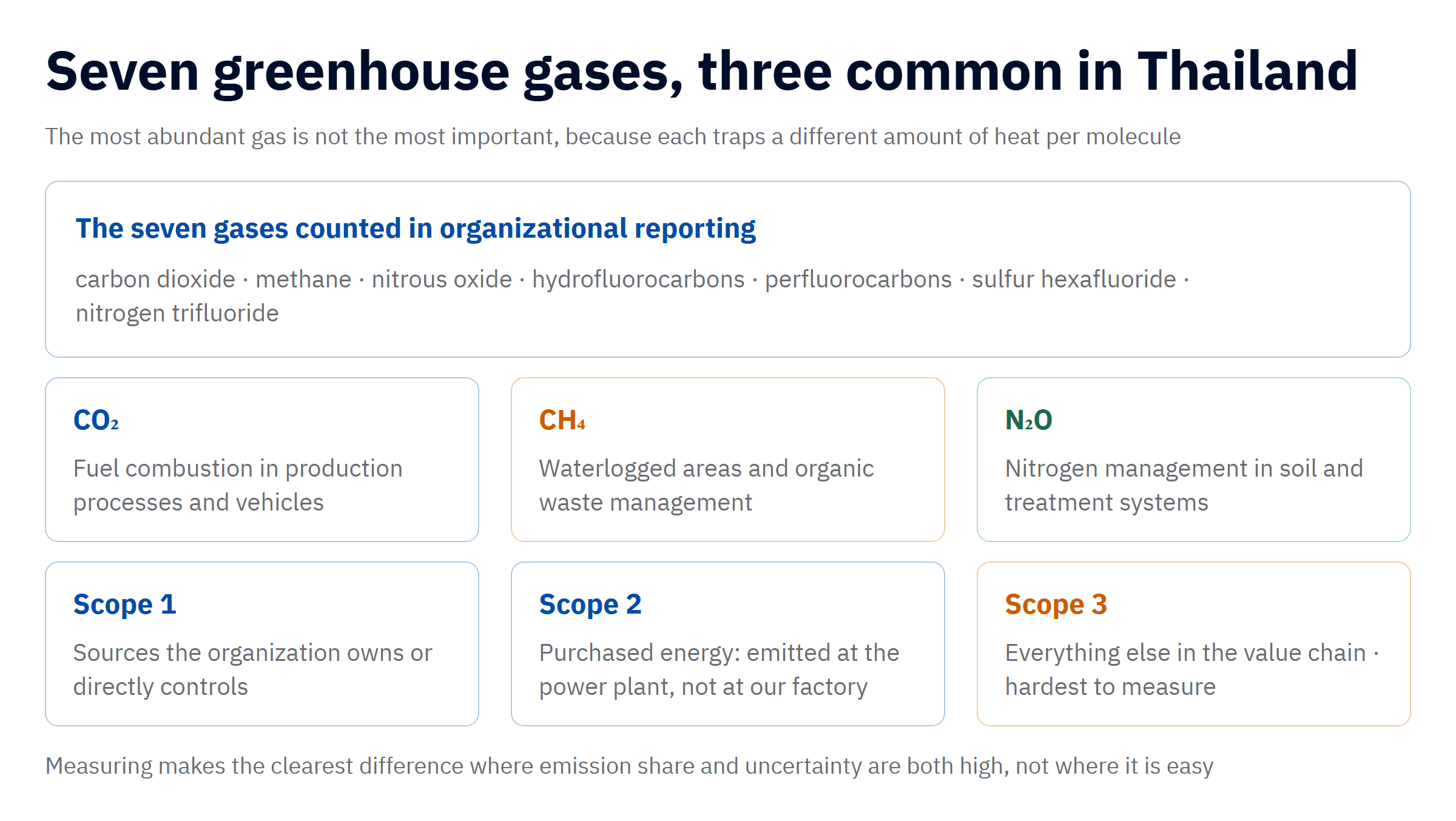
Organizational reporting generally counts seven gases: carbon dioxide, methane, nitrous oxide, hydrofluorocarbons, perfluorocarbons, sulfur hexafluoride and nitrogen trifluoride.
A common misconception is that the most abundant gas is the most important one. In fact, each gas traps a different amount of heat per molecule. A gas present in the air at very low concentrations can therefore still carry real weight in an emissions inventory.
In practice, the three gases most often encountered in Thai industry and agriculture are carbon dioxide, methane and nitrous oxide. Methane is linked to waterlogged areas and the management of organic waste. Nitrous oxide is linked to nitrogen management in soil and in treatment systems.
How Scope 1, Scope 2 and Scope 3 differ
Organizational emissions reporting is divided into three scopes.
Scope 1 covers emissions from sources the organization owns or directly controls, such as fuel combustion in production processes and in company vehicles.
Scope 2 covers indirect emissions from purchased energy. These emissions occur at the power plant, not at your own factory.
Scope 3 covers all remaining emissions in the value chain, both upstream and downstream.
Scope 3 is the hardest to measure because most of the data is not in your hands. It has to be requested from business partners, and each partner collects data differently and at a different level of detail. Many organizations therefore start with generic average values and replace them with measured data later.
Direct measurement usually makes the clearest difference for activities that have both a high share of emissions and high uncertainty. When deciding where to invest in measurement, start from these two conditions, not from what is easiest to measure.
The two main measurement techniques and how they differ
1. NDIR (Non-Dispersive Infrared)
The first technique is NDIR, short for Non-Dispersive Infrared. It measures how much infrared light the gas absorbs. The design is simple, it stands up well to field use, and it gives good results for carbon dioxide in typical concentration ranges.
It works by passing infrared (IR) light through a cell that holds the sample gas. Each gas (for example CO₂, CH₄ or CO) absorbs IR light at its own characteristic wavelengths. A detector at the far end measures how much light is left. The higher the gas concentration, the more light is absorbed.
Strengths: a simple design, robust in the field, easy to use, low maintenance and lower cost.
Limitations: moderate sensitivity (readings in % or ppm), possible signal drift over time, and interference from humidity and temperature.
2. CRDS (Cavity Ring-Down Spectroscopy)
The second technique is CRDS, short for Cavity Ring-Down Spectroscopy. A laser beam is sent into a cavity lined with high-reflectivity mirrors, and the instrument measures how fast the light signal decays. Because the light bounces back and forth many times, the effective path length is very long. This makes CRDS better at detecting gases at low concentrations, and it can also measure isotope ratios.
It works by sending a laser beam into a cavity with very high-quality mirrors (reflectivity above 99.99%) at both ends. The light bounces back and forth tens of thousands of times, so the distance it travels through the sample gas is equivalent to a tube several kilometers long. The system then switches the laser off and measures the time it takes for the light intensity to decay (the ring-down time).
Strengths: very high precision and sensitivity, easily measuring gases at ppb (parts per billion) or ppt (parts per trillion) levels. It can also distinguish molecular isotopes (for example, telling rainwater from groundwater) and is little affected by temperature.
Limitations: higher cost, a more delicate construction, maintenance by specialists, and mirrors that must be kept absolutely clean.
Two soil gas flux systems from the same product line show the difference clearly.
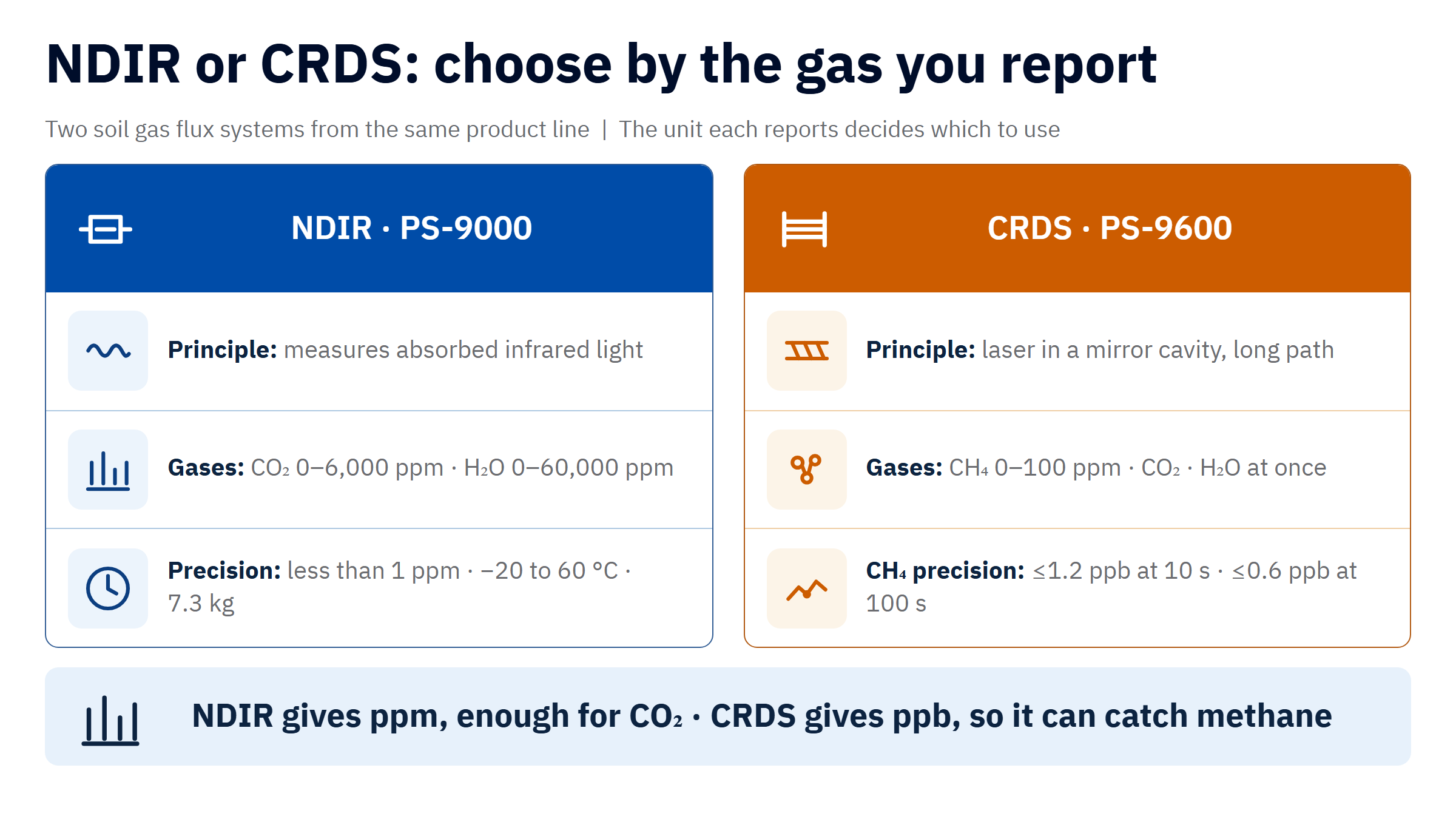
The LICA PS-9000 uses the NDIR principle. It measures carbon dioxide from 0 to 6,000 ppm and water vapor from 0 to 60,000 ppm, with accuracy of less than 1% of reading and precision of less than 1 ppm. It operates from -20 to 60 °C and weighs 7.3 kg including the battery.
The LICA PS-9600 uses the CRDS principle and measures methane, carbon dioxide and water vapor at the same time. Methane precision is no more than 1.2 ppb at a 10-second averaging time and no more than 0.6 ppb at 100 seconds. The methane measurement range is 0 to 100 ppm.
The measurement principle explains the difference between these two sets of figures. NDIR reports in ppm, which is sufficient for carbon dioxide work. CRDS reports in ppb, which is necessary when you need to measure methane or nitrous oxide, whose atmospheric concentrations are much lower.
How to choose the right technique for your work
Choose NDIR if you need to monitor air quality in factories, buildings or ventilation systems, or detect toxic gases for safety, where ppm-level readings are enough. For biogas measurement, mainly carbon dioxide, or work that means moving the instrument often, NDIR already meets the need.
Choose CRDS if you do research, collect environmental data or measure flux and need the highest precision. For continuous data collection at multiple points, some systems support several chambers on a single instrument, such as the LICA SF-9000, which connects to 1–18 chambers, and the SF-3500, which measures carbon dioxide, nitrous oxide, methane and ammonia, as well as isotopes, and is controlled through an Android app. CRDS is also the choice in high-tech industries (such as semiconductor manufacturing), where even a trace of contaminant gas can cause damage, or when you need isotope ratio data to identify where a gas comes from. Picarro provides complete systems to support this work, along with standard methods ready to use.
If your work focuses specifically on measurements from soil and agricultural land, we cover that in a separate article.
What to prepare besides the instrument
Calibration standard gases that match the concentration range you will actually use.
Chambers and mounting bases suited to the surface, if you are measuring flux.
A data logging system and power supply, especially for setups left running continuously.
Control of moisture and condensation in the gas sample lines, which is the most common cause of problems in the field.
A plan for calibration and for performance checks between calibration cycles.
Frequently asked questions
How many greenhouse gases are there, and which matters most for industry?
Organizational reporting generally counts seven gases. In Thai industry and agriculture, the three most common are carbon dioxide, methane and nitrous oxide. Importance does not depend on quantity alone. It also depends on how much heat each molecule can trap.
How do I choose between NDIR and CRDS?
If you measure carbon dioxide at typical concentrations and need portability, NDIR is sufficient and better value. If you need to measure methane or nitrous oxide at ppb levels, measure several gases at once, or need isotope data, you need CRDS.
What is the difference between measuring concentration and measuring flux?
A concentration measurement tells you how much gas is in the air at that spot. A flux measurement tells you the rate of exchange between the surface and the atmosphere per unit area per unit time. It requires a chamber and measurement of how the concentration changes over time.
What should I use to calibrate a gas analyzer?
Use standard gases with known, traceable concentrations, chosen to cover the range you actually work in. As with other types of analyzer, you should also run performance checks between calibration cycles.
If my budget is limited, where should I start?
Start by pinning down which gas you need to measure, at roughly what concentration, at how many points, and whether you need data over set periods or continuously. These four points will narrow your options more than starting from the budget, and they help you avoid buying an instrument that is more sensitive than you need or not capable enough.