

Factories that must report effluent quality face the same questions every year: which parameters are worth running in their own lab, which should be sent out, and where automated analyzers can actually help.
This article does not set out to copy the table of standard limits for you yet again, since it is easy to find. Instead, it looks at a side people often overlook. The notification in force does not only set how high each value may be. It also sets which method must be used to measure it, and that is what decides which instruments your lab needs.
The notification in force, and what it sets out
The general standard for wastewater discharge from factories is the Ministry of Industry notification setting standards to control wastewater discharge from factories, 2017 (B.E. 2560).
This notification always sets out two things side by side: the standard limit for each parameter, and the test method referenced for that parameter.
The main parameters to be reported are BOD, COD, suspended solids, TKN, oil and grease, sulfide, cyanide, phenolic compounds, free chlorine and heavy metals, together with color, which is limited to no more than 300 ADMI.
As examples of how the main parameters are measured: BOD is incubated at 20 °C for 5 days and taken as the difference in dissolved oxygen, COD uses chemical digestion followed by measurement, suspended solids are filtered and weighed dry, and the nitrogen and phosphorus group uses a color-forming reaction followed by an absorbance measurement. The point to check is whether the method your lab uses matches the method the notification references, because a result that is numerically correct but produced by a different method is not the same thing.
A practical tip: open the notification that applies to your type of business, and always read the test-method column alongside the limit column. Some types of business have their own specific notifications with requirements that differ from the general one.
BOD takes the most time and the most staff effort
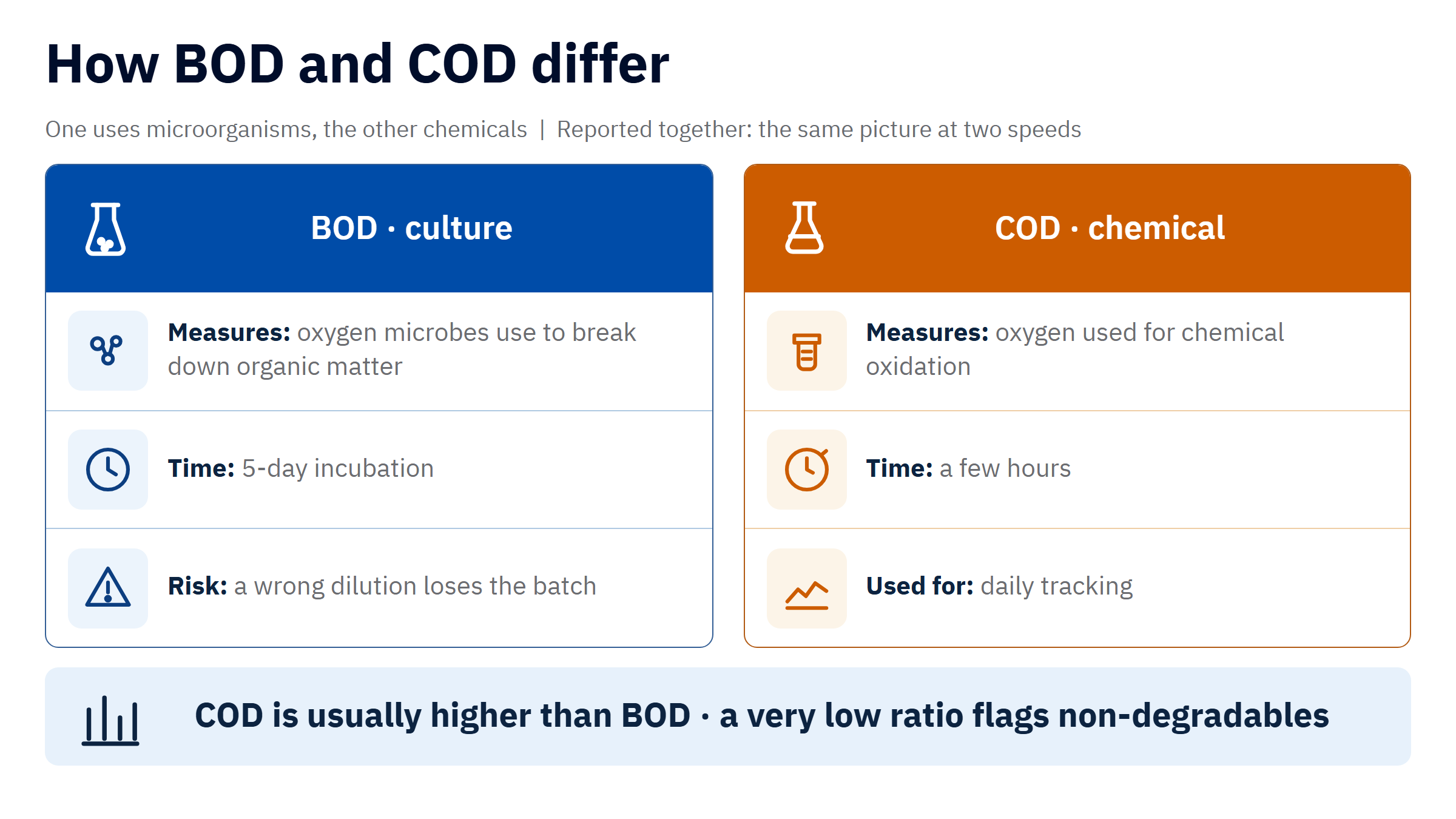
BOD, or biochemical oxygen demand, is the amount of oxygen that microorganisms use to break down organic matter in water. It shows how dirty our effluent is and how much pollution it puts on the receiving water body.
What sets BOD apart from other parameters is that it is not an immediate measurement but a biological test that has to wait for the microorganisms to work. The sample is diluted into the measurable range, a microbial seed is added, and dissolved oxygen is measured on day one. The bottle is then sealed and incubated in a temperature-controlled cabinet at 20 °C for 5 days before it is measured again. The result is the difference between the two readings.
So the real time sink is not the measurement but getting the sample dilution into the right range. If the dilution is wrong, the result falls outside the valid range, and you only find out 5 days later. The whole batch then has to start again.
An automated BOD system therefore does not shorten the 5-day incubation. What it changes is that preparation, dilution, measurement and recording no longer depend on someone being there on schedule. It also lowers the chance of losing a whole batch because of one missed step.
How COD differs from BOD, and why the two are reported together
COD, or chemical oxygen demand, measures the oxygen used to oxidize organic matter with chemicals rather than with microorganisms. Results therefore come within a few hours instead of 5 days.
COD is usually higher than BOD in the same sample, because COD covers all the organic matter that can be oxidized chemically, both the part microorganisms can degrade and the part they cannot, while BOD counts only the part microorganisms can degrade.
The ratio between the two is therefore more useful than either number alone. An unusually low BOD-to-COD ratio means the water contains a lot of material that microorganisms cannot break down. That is a sign the biological treatment system may not be able to cope, and you should look upstream at what is entering the system.
In practice, many labs track COD daily because results come quickly, and use BOD as the value reported each reporting period. Having both is not duplication. It is the same picture seen at two different speeds.
Nitrogen and phosphorus: where automation pays off most
This group includes ammonia, nitrate, nitrite, orthophosphate, total phosphorus and TKN. Most are analyzed with a color-forming reaction followed by an absorbance measurement.
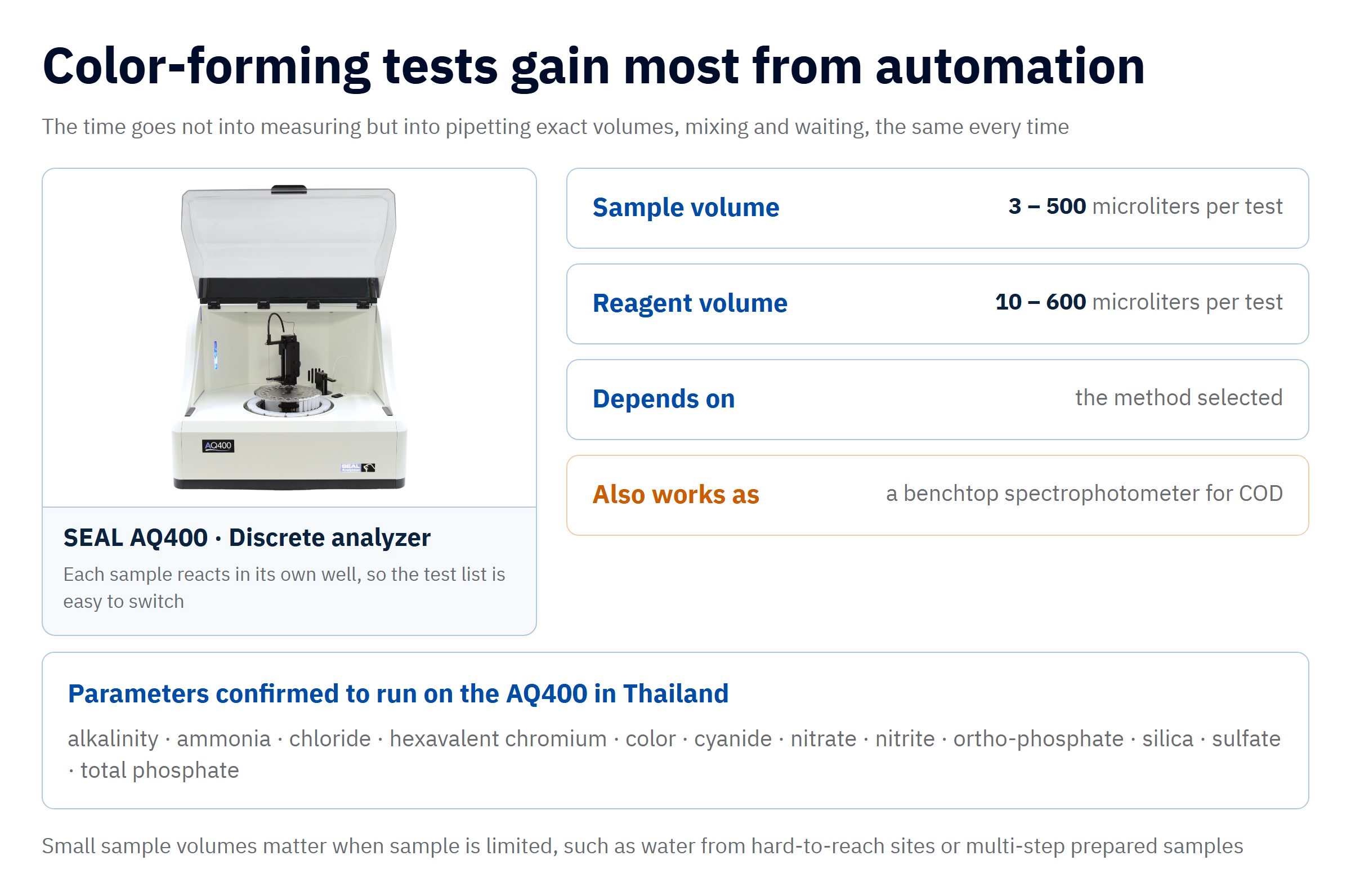
This group gains the most from automation because the time-consuming step is not the measurement. It is pipetting sample and reagents to exact volumes, mixing, and waiting for the full reaction time. This work is repeated the same way every time, and it is where human error happens most often.
Two main families of instruments handle this work. The first is the Discrete analyzer, where each sample reacts in its own reaction well. It suits labs where each sample batch needs a different set of tests, because the test list is easy to switch.
The second is the Continuous Flow Analyzer of the Segmented Flow type, where sample and reagents flow continuously through tubing, separated into segments by air bubbles. It suits high sample numbers with a fairly fixed test list, and it can handle in-line sample preparation steps such as continuous distillation or digestion.
One Discrete analyzer used in environmental work is the SEAL AQ400. It uses 3 to 500 microliters of sample and 10 to 600 microliters of reagent per test, depending on the method selected. This matters when sample volume is limited, for example water from sites that are hard to sample, or samples that have already been through several preparation steps.
Parameters we confirm can be run on the AQ400 in Thailand are alkalinity, ammonia, chloride, hexavalent chromium, color, cyanide, nitrate, nitrite, ortho-phosphate, silica, sulfate and total phosphate.
The AQ400 can also be used as a benchtop spectrophotometer for COD. This works differently from the color-forming tests, where the instrument automates the whole process. It is worth discussing the details with our team before deciding whether to run COD on the same instrument or separately.
Summary: which parameters are worth automating
The clear case is parameters measured with a color-forming reaction and optical detection: ammonia, nitrate, nitrite, phosphate, cyanide and color. The instrument takes over all of the pipetting and mixing.
BOD pays off in a different way. The instrument does not shorten the incubation time, but it means staff do not have to keep watch over the incubation schedule, and it reduces errors between steps.
For parameters that are run infrequently or have few samples, look at the workload first. Investing in automation may not yet pay off compared with doing them by hand.
So the question to answer before deciding is not which brand is best. It is how many samples you have per month, how many parameters you must report, how low the values you must report go, and at which step time is currently being lost.
What to prepare besides the instrument
Reagents and consumables matched to the number of parameters and your actual workload.
Reference materials for checking performance between calibration rounds.
Space for the instrument and ventilation suited to the reagents used.
Purified water of consistent quality, which directly affects blank values.
A calibration and routine maintenance plan, including parts that wear with use, such as pump tubing and seals.
User training, and connection to the results recording system you already use.
Support after installation in Thailand
Analyzers in this group are not finished on installation day. Parts in contact with reagents wear with use, and drifting results almost always start with these parts.
Thai Unique supports this work with a team that understands the chemistry behind the analytical methods, not just which buttons to press. This lets the team tell whether a deviation comes from the instrument, the reagents or the sample preparation.
Most on-site issues can be resolved within Thailand. The real limitation we see is that some spare parts have to be ordered in, not technical capability. We state this here so expectations are set correctly from the start.
Frequently asked questions
How do BOD and COD differ, and why is COD usually higher?
BOD measures the oxygen that microorganisms use to break down organic matter, while COD measures the oxygen used in chemical oxidation. COD therefore covers substances that microorganisms can and cannot degrade, so it is usually higher in the same sample.
COD is unusually high. Where should we start looking for the cause?
Start by checking whether a new type of waste is entering the system, then compare the BOD-to-COD ratio. If the ratio has dropped, the incoming material is hard to break down biologically, and you should look at the upstream process rather than only adjusting the treatment system.
What can cause high ammonia in water?
Common causes are incomplete nitrification in the treatment system, more nitrogen-rich waste entering the system than it was designed for, and changed conditions that reduce microbial activity, such as temperature or pH.
If we have to report daily, at what volume does it pay to buy our own instrument?
There is no single figure that applies everywhere. It depends on the number of parameters per sample, how often you report, and the labor currently spent on preparation. The most direct approach is to count your actual samples and parameters over one month, then let us help you assess where the break-even point is.
Once we have bought an instrument, who services and calibrates it in Thailand?
Thai Unique has a service team in Thailand that covers installation, user training, scheduled calibration and on-site troubleshooting. We also service instruments in the chromatography, flow analyzer and spectrophotometer groups, even if they were not bought from us. The limitation we have is some spare parts, not technical capability.