

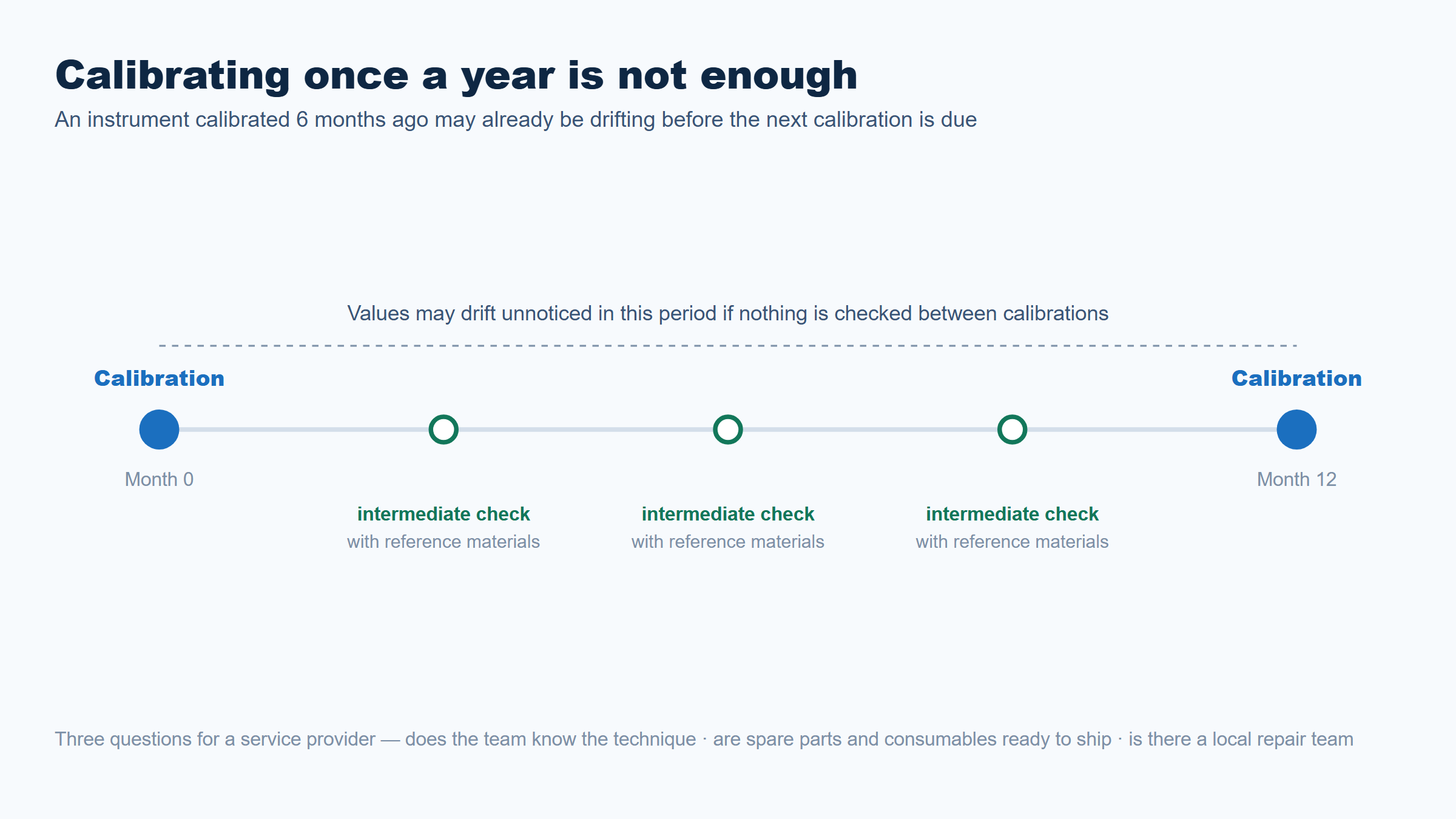
Analytical instruments in the laboratory are generally calibrated at least once a year. Their performance should also be checked between calibrations (intermediate checks) with reference materials at regular intervals, because an instrument that passed calibration 6 months ago may already be giving drifted results before the next calibration is due. There are three questions to ask a service provider: does the team that comes on site really understand the instrument’s technique, are spare parts and consumables ready to ship, and when the instrument has a problem, is there a team in the country that can fix it?
Thai Unique provides this support with a team of PhD-level specialists based in Thailand.
Calibration, performance checks and preventive maintenance: what is the difference?
These three terms are lumped together so often that many labs buy the wrong service, then only realize it when their analytical results start to show problems. All three are necessary and none can replace another, because each one answers a different question.
| Service | Answers the question | When to do it |
|---|---|---|
| Calibration | How closely do the instrument’s readings match the reference values? | On a set schedule, generally at least once a year |
| Intermediate check (performance check between calibrations) | Has the instrument started to drift since its last calibration? | At intervals between calibrations, using reference materials |
| Preventive maintenance | Is it time to replace worn parts? | According to the service life of the parts, not the calibration schedule |
The most common mistake is to assume that an instrument that passed calibration is good for the whole year. In fact, calibration only shows the instrument’s condition on the day it was done. An instrument with deteriorating parts, such as pump tubing, seals or the light source lamp, will drift out of specification sooner than the planned calibration cycle.
So a plan that works in practice includes all three in one schedule, rather than choosing only one of them.
How often should you calibrate?
The standard answer is at least once a year, but the right frequency really depends on three factors. Labs that set their cycle based on these three spend less than labs that set it out of habit.
1. How often the instrument is used
An instrument that runs every day all year wears faster than one used only a few times a month. Using the same cycle for both means one is calibrated more often than needed and the other not often enough.
2. How critical the reported results are
Results submitted to regulators, results used to decide whether a product passes or fails, and results used internally to watch trends do not carry the same cost of error. Work where an error causes more damage should be checked more often.
3. The requirements of the lab’s quality system
If the lab works under a quality system that sets a calibration interval, treat that as the minimum. Then decide whether to calibrate more often based on the first two factors.
Between calibrations, check performance with reference materials at regular intervals. The reason is not paperwork, but damage that can be prevented. If you cannot tell at the next calibration when the instrument started to drift, you will have to re-check all the results from that whole period, which costs far more than checking between calibrations.
Signs an instrument will drift out of specification before its calibration is due
In our field service work, instruments usually give warning signs before they produce clearly wrong results. You can read these signs from data the lab already has, with nothing extra to buy.
- The standard curve is no longer linear — check r², which shows how linear the curve is. If r² is below 0.98, the cause usually traces back to how the standard solutions or reagents were prepared, not to the instrument itself.
- The baseline is higher in every measurement — in colorimetric analyzers, this usually comes from deposits in the cuvette or flow cell.
- LOD and LOQ rise without any change in method — a common cause is a light source lamp nearing the end of its life. As light intensity falls, the absorbance of both the samples and the standard curve shifts together, and noise increases.
- Results for the same sample are no longer repeatable — if the same set of control samples gives values that differ more and more, that is a systematic signal, not chance.
- Dispensed volumes are no longer consistent — worn pump tubing causes errors in the aspirating and dispensing rate, which distorts the curve and the analytical results. Pump tubing is a consumable that should have a clear replacement schedule.
If you see two or more of these signs at the same time, do not wait for the annual calibration. While you wait, results that have already been reported may later need to be re-checked.
3 questions to ask before choosing a service provider
There are many calibration service providers, and their quotations often look so similar that they are hard to compare. These three questions show the differences fastest.
1. Does the team that comes on site really understand the instrument’s technique?
This is not the same as knowing how to run through a calibration procedure. Someone who understands the technique can tell you what is causing a deviation and where it should be fixed, rather than just issuing a pass or fail certificate. A simple test is to describe a problem you have had and see whether they can analyze it.
2. Are spare parts and consumables ready to ship?
This determines how long the instrument will be out of action when something goes wrong. A provider that has to order parts every time something fails will always leave the lab down for longer than expected.
3. When the instrument has a problem, is there a team in the country that can fix it?
This is different from asking whether there is a local representative, because having a sales representative is not the same as having people who can actually solve technical problems. Ask directly which kinds of cases require the instrument to be shipped abroad.
What Thai Unique’s team can do for you
Thai Unique’s instrument support does not start when an instrument breaks down. It starts while the lab is still choosing its analytical method, and continues through installation, scheduled calibration, user training and condition checks between calibrations. All of this is done by a team based in Thailand.
What makes a service different is not replacing parts by the manual, but being able to tell whether a symptom comes from the instrument, the reagents or the sample preparation. Our team are PhD-level specialists who work directly with these analytical techniques. We can discuss problems with users at the level of the analytical method, not just the instrument, and we can often identify the cause on the first site visit.
Instrument groups we support
The instruments we support fall into three main groups: sample digestion and extraction systems, automated water analyzers, and gas analyzers. We also support chromatography instruments, both LC and GC, as well as flow analyzers and spectrophotometers, even if they were not bought from us.
Most work can be completed in Thailand. Only cases where the main structure or a specialized component is damaged still need to be sent back to the manufacturer’s factory for repair. The more common limitation is therefore not technical capability, but spare parts for brands we do not represent, which may take longer to source.
What to prepare before the service engineer arrives
Preparing these two things in advance lets the job be finished in a single visit, instead of needing a second appointment.
- A list of the consumables you have on hand — so the team knows in advance what else to bring and does not waste a trip because something is missing.
- Any reference materials or standards you want checked in particular — if you have doubts about a parameter, prepare the material and tell us in advance, so the team can plan checks that cover it from the start.
It also helps a lot to write down the symptoms you have seen beforehand, together with what you have already checked yourself. This information greatly shortens the diagnosis and helps us judge more quickly what needs to be replaced.
Beyond service, analytical instruments, spare parts and consumables for the brands we represent are also available in Thailand through Thai Unique.
If you would like us to assess an instrument’s condition or plan a calibration schedule for you, contact us: Tel. 0-2629-0191-6 · customer.service@thaiunique.com
Frequently asked questions
How often should instruments be calibrated?
Generally at least once a year, but the right frequency depends on how often the instrument is used, how critical the reported results are, and the requirements of the lab’s quality system. Between calibrations, check performance with reference materials at regular intervals. That way you know early when the instrument starts to drift, instead of finding out at the next calibration and having to re-check a whole year of results.
What is the difference between calibration and preventive maintenance?
Calibration checks how closely the instrument’s readings match the reference values. Preventive maintenance replaces parts that wear out according to their service life, such as pump tubing, seals or the light source lamp. Both are necessary and neither can replace the other, because an instrument with deteriorating parts will drift out of specification sooner than the planned calibration cycle.
Is there a calibration team in Thailand, or do instruments have to be sent abroad?
We resolve more than 95% of the problems we encounter within Thailand. Only cases involving damage to the main structure or a specialized component need to be sent back to the manufacturer’s factory for repair. Contact us: Tel. 0-2629-0191-6 · customer.service@thaiunique.com
How are calibration service fees calculated?
Fees depend on the type of instrument, the number of points to be calibrated, the reference materials required and the location. We therefore quote case by case. When you contact us, tell us the instrument model, the number of instruments and the province where they are installed, and we will prepare a service plan that fits how your lab uses them.
We bought our instrument elsewhere. Can you still support it?
Yes. Thai Unique’s team of PhD-level specialists calibrates and supports chromatography instruments (LC, GC), automated water analyzers of the flow analyzer / CFA type, and spectrophotometers, even if they were not bought from us. The most common limitation is not technical, but spare parts and consumables for brands we do not represent, which may take longer to source. The fastest way forward is to send us the brand, model and symptoms so we can assess them first.