
Sample preparation shapes the quality of analytical results more than many people think. It splits into two routes, depending on the analyte and the matrix being analyzed. The first route is digestion, for elemental analysis by ICP-OES, ICP-MS or AAS. Closed-vessel microwave digestion gives higher and more uniform temperatures than digestion on a hot plate, so it breaks samples down more completely and loses fewer volatile elements. The second route is solvent extraction, for organic compounds and PFAS work. Here the main challenge is not how aggressive the digestion is, but controlling contamination and keeping every run consistent.
How many sample preparation routes are there, and how do you choose?
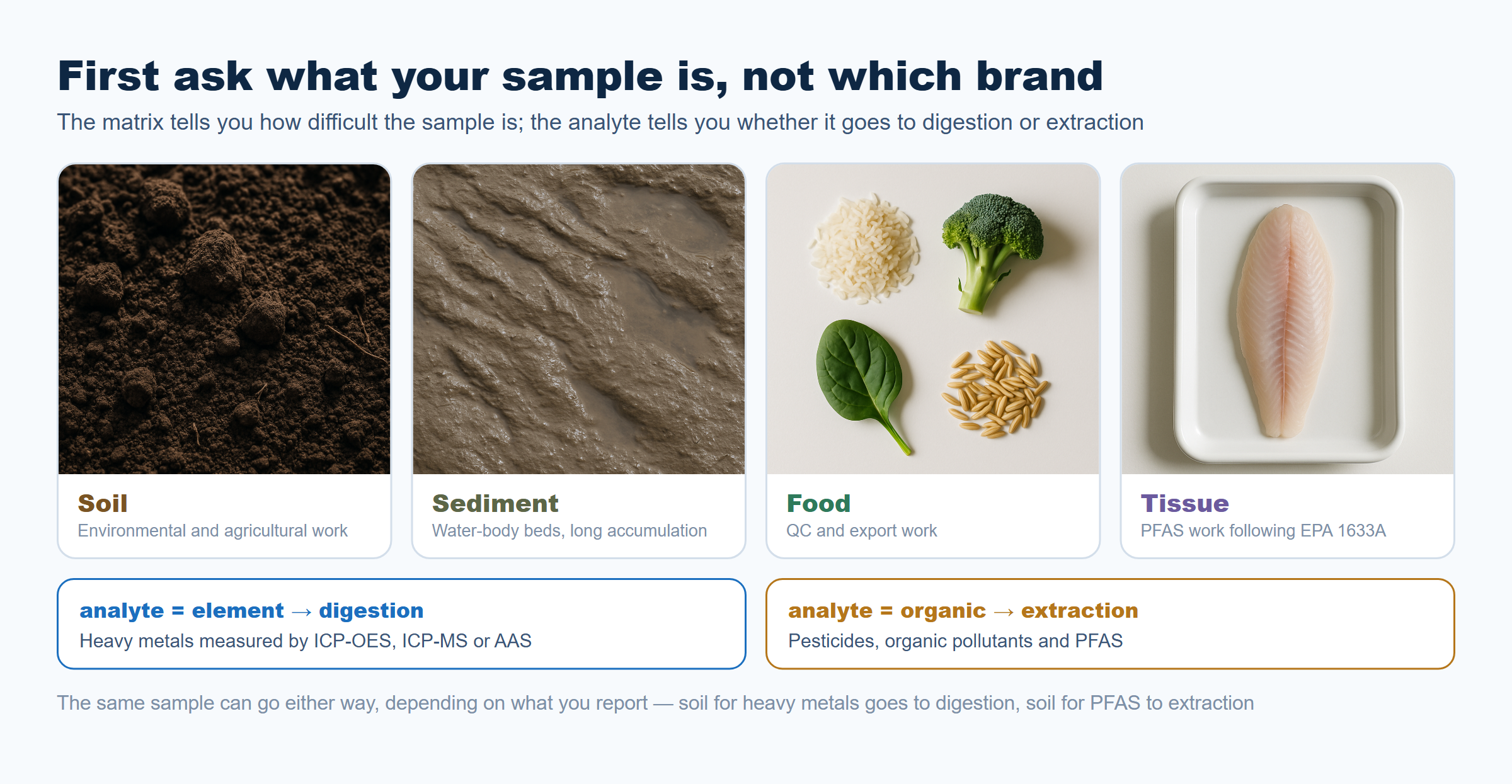
The question to ask before choosing sample preparation equipment is not “what instruments does our lab have?” but “what are we analyzing, and in what kind of sample?” These two factors, the analyte and the matrix, determine the route you need to follow, not the brand or model of the instrument.
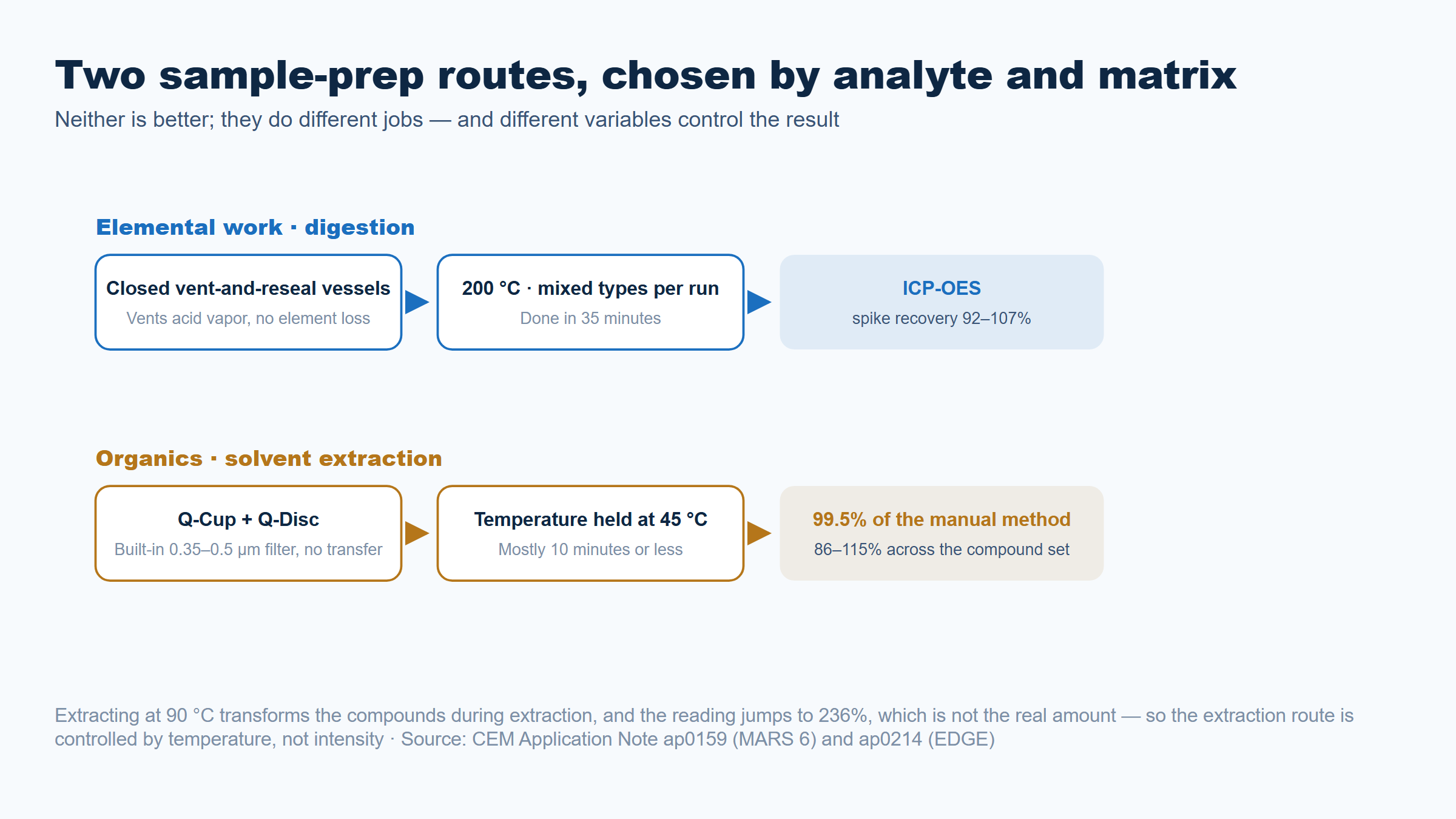
If the analyte is an element, such as heavy metals analyzed by ICP-OES, ICP-MS or AAS, the goal of sample preparation is to release all of the elements of interest from the sample into solution. That is digestion.
But if the analyte is an organic compound, such as pesticides, organic pollutants or PFAS, the goal changes: extract the target compounds without destroying them, and without letting anything from the equipment get into the sample. That is solvent extraction.
These two routes use different types of instruments and are judged by different criteria. Using an instrument from one route for work on the other often gives results that cannot be reproduced, which then shows up at QC with no cause that can be found.
| If the analyte is | Route | Goal of the step | Deciding criteria |
|---|---|---|---|
| Elements / heavy metals (ICP-OES, ICP-MS, AAS) | Digestion | Break down the sample matrix so all of the elements go into solution | Temperature, pressure and loss of volatile elements |
| Total nitrogen / total phosphorus (TKN) | Block digestion | Digest dozens of samples at a time at a low cost per sample | Number of positions per run and control of the temperature profile |
| Organic compounds in soil, sediment, food | Solvent extraction | Extract the target compounds without destroying them, and keep every run the same | Run-to-run consistency and the volume of solvent used |
| PFAS | Extraction with a PFAS-free system | As above, plus control of contamination from the equipment itself | Parts that contact the sample must be tested and shown to be PFAS-free |
Route 1 — Digestion for elemental analysis: why this step determines result quality
When heavy metal results come out lower than they should, or replicates do not agree, the cause is often not the measuring instrument at the end, but the digestion step, and it is usually one of these three issues.
1. Temperature too low or uneven
A hot plate does not heat evenly across its surface. Vessels at the edge and vessels in the center see different conditions. As a result, some samples digest completely and others do not, and the values scatter.
2. Open systems lose volatile elements
Elements such as mercury or arsenic can be lost during digestion if the vessel is not closed. The reported value will be lower than the true value, with no warning sign at all.
3. Atmospheric pressure caps the temperature
At atmospheric pressure, an acid boils at a certain temperature and cannot get any hotter. Closed-vessel microwave digestion lets the temperature rise above the acid’s boiling point at atmospheric pressure, so samples break down more completely.
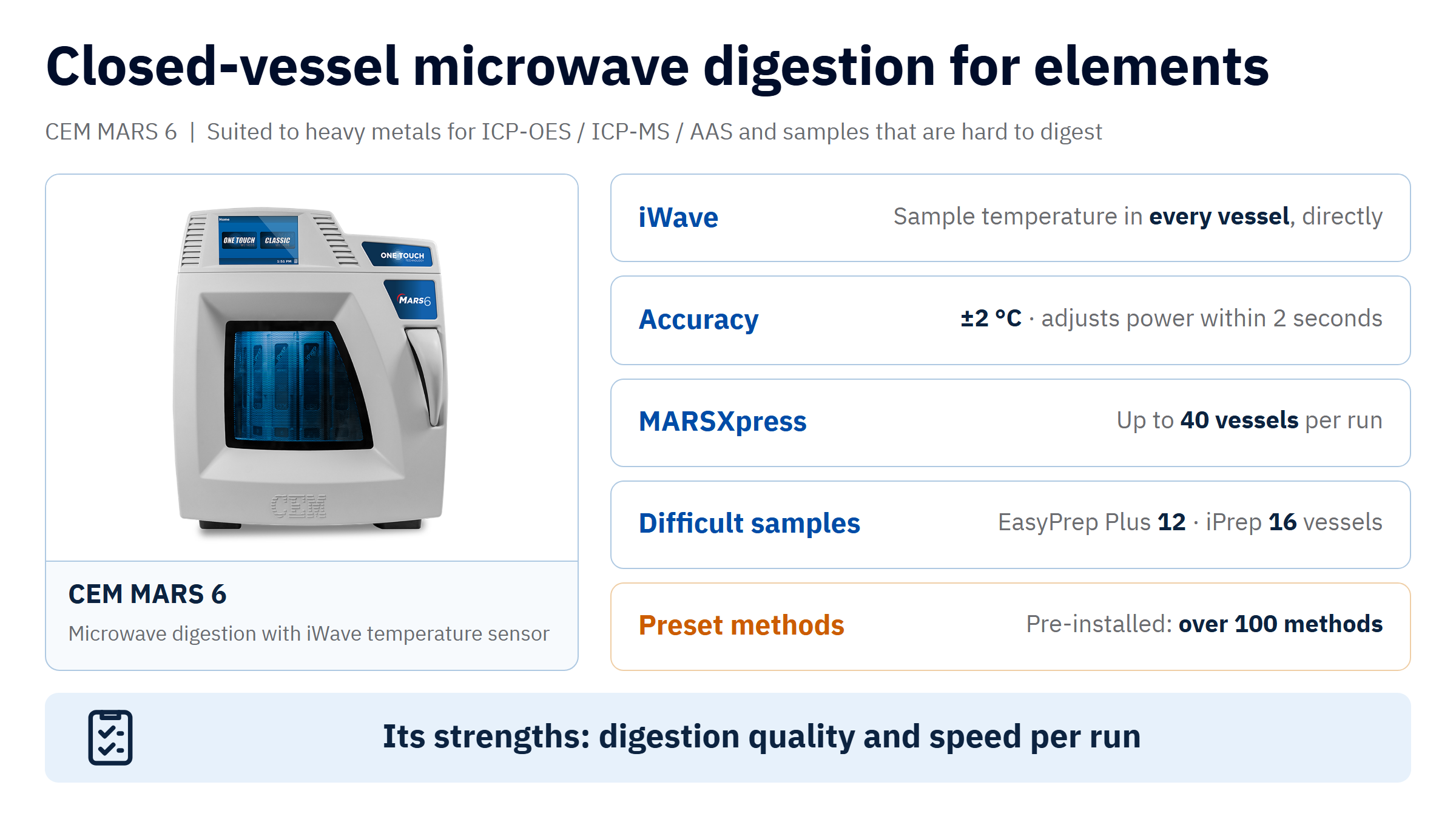
CEM MARS 6 is a microwave digestion system designed to address all three of these issues. CEM states that it reduces sample preparation time by more than 70% compared with traditional techniques.
How do you achieve the temperature control that USEPA methods require?
USEPA methods for sample digestion do not only specify which acid to use and for how long. They also specify the temperature profile the sample must go through. The question that follows is: in practice, how do you know that the sample in each vessel really reaches those temperatures?
Typical microwave digestion systems measure the temperature of one control vessel and assume the other vessels are the same. This costs one position in every run, and if the samples in the other vessels have a different composition, the reading is only a proxy, not the actual value for those vessels.
iWave on the MARS 6 uses contactless, in-situ measurement: it measures the temperature of the sample in each vessel directly, without a control vessel or probe. No position is lost to a control vessel, and you know how hot each vessel really is.
The sensor gives temperature readings accurate to ±2 °C and adjusts microwave power within 2 seconds of receiving a reading. This is what makes the temperature profile set by the method actually happen in every vessel, not just in the one being measured.
Microwave digestion or block digestion: which suits which work?
This question cannot be answered with “which one is better”, because the two approaches meet different needs. Microwave wins on digestion quality and speed per run, while block digestion wins on samples per run and cost per sample.
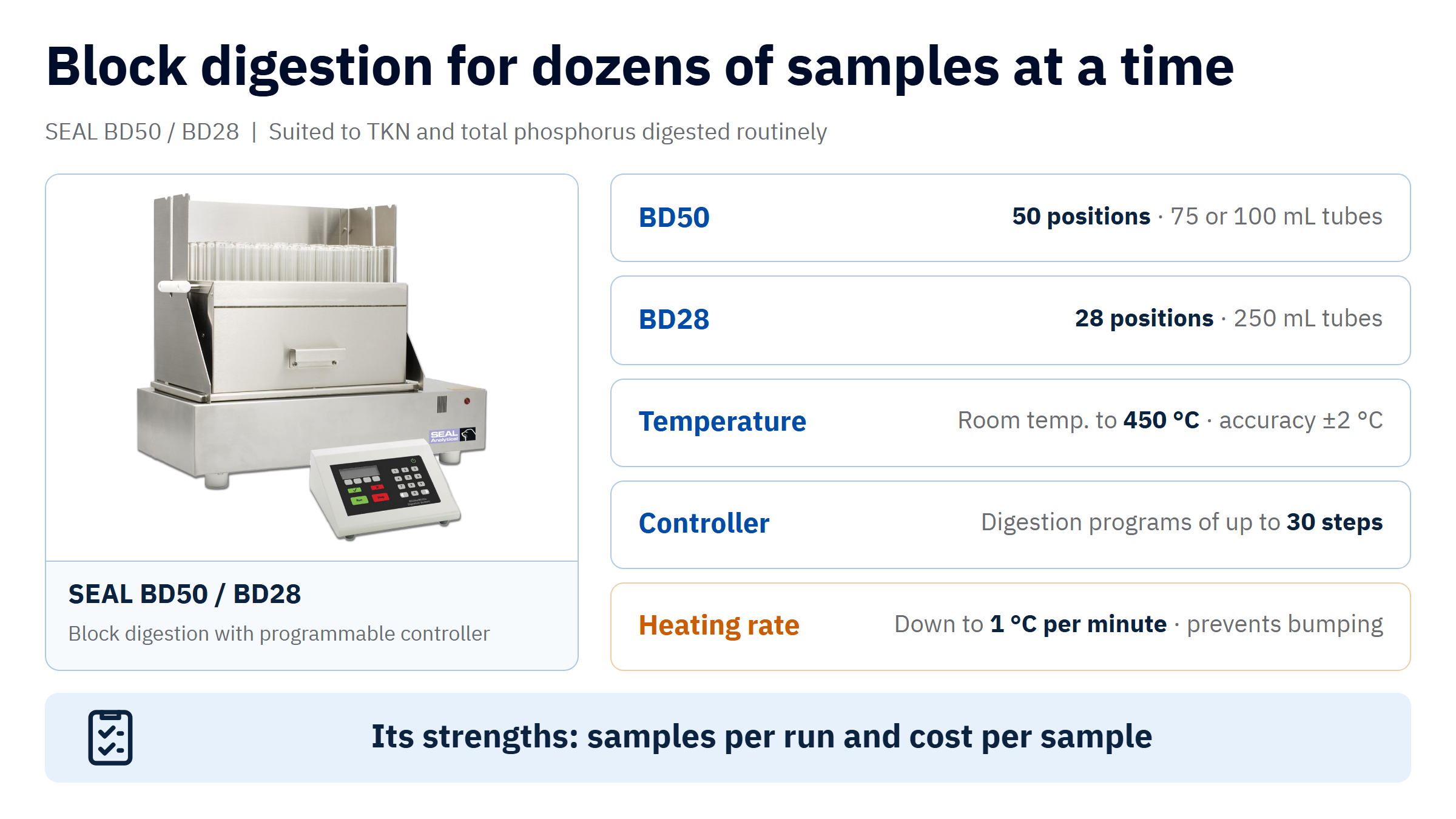
Work where block digestion is still clearly more cost-effective is Total Kjeldahl Nitrogen and total phosphorus, when dozens of samples are run at a time on a routine basis. The SEAL BD50 holds 50 positions for 75 or 100 mL digestion tubes, while the BD28 holds 28 positions for 250 mL digestion tubes.
What is often overlooked when comparing block digestion systems is the quality of the controller and surrounding accessories, not just the number of wells. The BD50 and BD28 controller can program digestions of up to 30 steps, set temperatures from room temperature to 450 °C with a set-point accuracy of ±2 °C, and control the heating rate as finely as 1 °C per minute, which is essential to prevent bumping.
Two other accessories have a direct effect on result consistency. A draft shield stops air currents in the fume hood from blowing across the digestion tubes, so every well stays at the same temperature. Teardrop stoppers trap and condense digestion vapors so they flow back down, reducing acid loss and preventing cross-contamination between digestion tubes.
| Comparison point | Microwave digestion (MARS 6) | Block digestion (BD50 / BD28) |
|---|---|---|
| Strengths | High, uniform temperature; closed system; complete sample breakdown | Samples per run and cost per sample |
| Capacity per run | Up to 40 vessels per batch (MARSXpress) | 50 positions (BD50) or 28 positions (BD28) |
| Best suited to | Heavy metals for ICP-OES / ICP-MS / AAS; samples that are hard to digest | TKN and total phosphorus run routinely, dozens of samples at a time |
| Volatile elements | Lower losses, because it is a closed system | Relies on teardrop stoppers to help reduce losses |
Choose digestion vessels for the work, not for what you already have
In a microwave digestion system, the vessels determine how many samples one run can take and how difficult a sample they can handle. These two always trade off: the vessels that fit the most samples per run are not the ones that withstand the highest pressure.
- MARSXpress — runs up to 40 vessels per batch, in 20, 55 or 75 mL volumes. It is the option for work that focuses on samples per run, such as service labs that receive samples in large batches.
- EasyPrep Plus — 12 vessels at 100 mL, for work that needs higher temperatures or pressures.
- iPrep — 16 vessels at 110 mL, another option for samples that are hard to digest.
The most reliable way to choose is to start from the most difficult sample in your routine work, not the one you run most often. Vessels that can handle difficult samples can also handle easy ones, but not the other way round.
As for methods, the system comes with more than 100 pre-programmed methods covering common sample types. Select one on the screen and start. You still need to choose a method that suits each lab’s sample matrix and analysis, so it is not entirely hands-off. For specialized samples, our team can help adapt the method.
Route 2 — Solvent extraction for organic compounds
Extracting organic compounds from soil and sediment takes time, solvent and staff supervision. The classic problem is that someone has to stand at the fume hood for the whole run, and each run ends up with different conditions because it depends on who does the work.
CEM EDGE is an automated solvent extraction system that combines pressurized fluid extraction and dispersive SPE in a single step. According to CEM’s documentation, the system meets the requirements of US EPA Method 3545A and is at least 3 times faster than other pressurized fluid extraction systems, with filtration, cooling and system rinsing built into a single run.
What really removes steps is the Q-Cup, a 3-piece assembly, together with the Q-Disc, which filters the sample as part of the process. There is no need to filter again before analysis, a step that takes time and is a point where the sample can pick up extra contamination.
In practice, this gives two results: staff who used to watch over the extraction step can move on to other tasks, and every sample set is kept under the same conditions in every run. The second point is what makes QC results more stable.
PFAS work adds another layer
PFAS has become a topic that exporters and factories are increasingly asked about, and the standard method cited most often is EPA Method 1633A. Thailand does not yet have legal requirements on PFAS, so for now the pressure comes mainly from downstream customers and export markets.
What sets PFAS work apart from general extraction work is not how difficult the extraction is, but contamination from the equipment itself. Parts inside the instrument that contain PFAS create a background that cannot be separated from the sample. This means that however good the measuring instrument at the end is, if the background comes from the sample preparation equipment, the results cannot be trusted.
CEM EDGE PFAS is designed specifically for this work. Every part that contacts the sample has been tested and shown to be PFAS-free, and the system automatically extracts, filters, cools and rinses itself before the next sample. CEM’s documentation states that this instrument extracts 40 PFAS compounds from soil and tissue, following EPA Method 1633A.
If your lab is assessing whether to take on PFAS work, the deciding point is not only the measuring instrument at the end. It is whether your sample preparation step can control background contamination.
Steps after sample preparation that are often skipped
Many labs invest in a digestion or extraction system and stop there, even though three further steps also affect the numbers they report.
- Volume adjustment — if the final volume is not made up consistently for every sample, all the effort to control temperature during digestion is wasted, because the values calculated back to the original concentration will be off as well.
- Filtration — samples that still contain particles interfere with both the sample introduction system and the detector. Some systems, such as EDGE, filter as part of the process with the Q-Disc, but with other methods you need to plan this step yourself.
- Storage before measurement — how long and at what temperature samples are stored while they wait for analysis affects some analyte groups, especially organic compounds. If the instrument queue is long, the storage conditions should be clearly defined in your workflow.
Choosing a sample preparation method that suits the analyte and matrix is not something the instrument specifications alone can answer. You also need to consider the standard methods you must use and the real characteristics of your samples. Thai Unique’s team are PhD-level specialists who work directly with sample preparation in Thailand. If you send us your sample type, the analytes you need to report and the standard methods you reference, we can help assess which approach to use. Contact: phone 0-2629-0191-6 · customer.service@thaiunique.com
For details of the products related to this article, see the pages for CEM MARS 6, CEM EDGE, CEM EDGE PFAS and the SEAL BD50 / BD28 block digestion systems.
The digestion and extraction systems discussed in this article are available in Thailand through Thai Unique, with installation, calibration and after-sales support teams based in the country.
Frequently asked questions
Is the only difference between microwave and hot plate digestion the speed?
No, it is not just speed. Closed-vessel microwave digestion reaches temperatures above the acid’s boiling point at atmospheric pressure, so samples break down more completely. Because it is a closed system, fewer volatile elements are lost. Every vessel also sees similar conditions, so results are more reproducible than on a hot plate, which does not heat evenly across its surface.
How many samples can be digested in one run?
It depends on the vessels you choose. MARSXpress vessels can run up to 40 vessels per batch in 20, 55 or 75 mL volumes. High-pressure vessels for difficult work, such as EasyPrep Plus, give 12 vessels at 100 mL, and iPrep gives 16 vessels at 110 mL. Work that focuses on sample numbers and work that focuses on difficult matrices therefore use different types of vessels.
Do we need to develop our own methods?
In most cases, you do not need to start from scratch. The system comes with more than 100 pre-programmed methods covering common sample types, though you still need to choose a method that suits your lab’s sample matrix and analysis. For specialized samples, our team can help adapt the method.
Can we use our existing digestion system for PFAS work?
We do not recommend it, because the main problem in PFAS work is contamination from the equipment’s own parts. A system designed specifically for this work has been tested to confirm that every point that contacts the sample is PFAS-free, and it includes a system rinse between samples to reduce carryover.
What needs to be prepared before installation?
Requirements for electrical supply, fume hoods and installation space differ by instrument type and model, so there is no single answer that fits every case. The most reliable approach is to tell us the model you are interested in and your site conditions, so we can check them before you decide to buy. We will then send you the installation requirements for that model.