
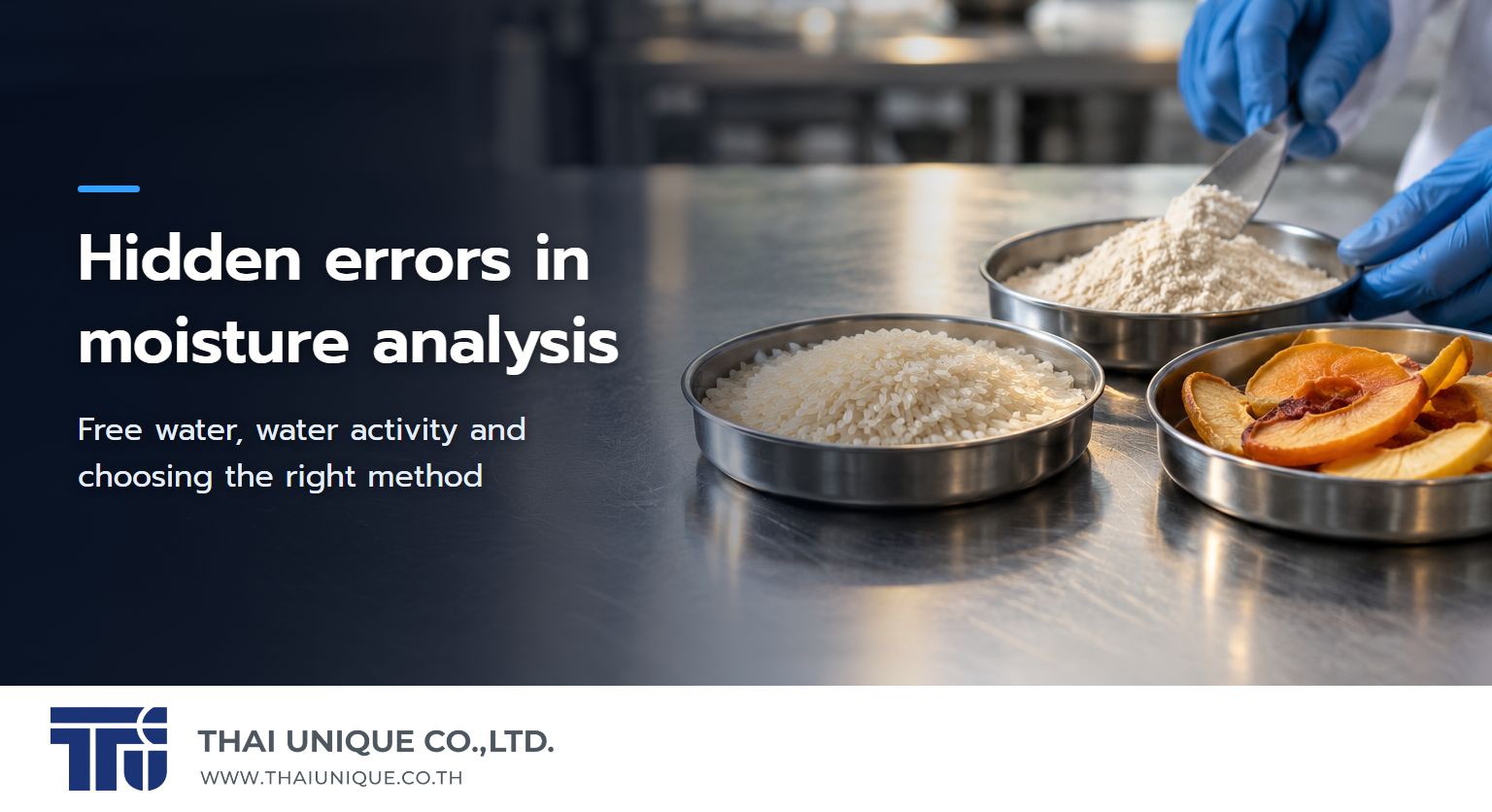
Moisture analysis is the measurement of how much water a sample contains, expressed as a percentage of its weight. The most common approach is to dry the sample and weigh what is lost (loss on drying), either in a drying oven, which is the reference method, or in a moisture analyzer that gives a result in minutes. Karl Fischer titration measures water specifically through a chemical reaction, while water activity does not measure the amount of water at all, but how available that water is to microorganisms.
So the moisture figure you report depends on the method you choose, not only on the sample. Does this sound familiar?
- Repeat measurements give different values
- The same sample, measured on different days, gives different results
- Results take so long that QC decisions come too late
Often, these problems are not caused by the person doing the measurement. They come from “the nature of the sample” and “the analytical method” that was chosen. This article covers both, from the kinds of water in a sample to choosing a method that fits the job.
What is moisture content in food, and why measure it accurately?
Moisture content is the mass of water divided by the total mass of the sample, multiplied by 100. What remains after the water is removed is the total solids, equal to 100 minus the percent moisture. Some industries report total solids instead, but it is the same number seen from the other side.
There are several reasons to measure it. Some foods have legal maximum or minimum moisture levels. Water is an inexpensive ingredient, so manufacturers aim to run close to the limit without exceeding it. Moisture also governs microbial stability, texture, taste and how materials behave during mixing, drying and packaging.
Small numbers carry real weight. For one tonne of product sold by weight, a moisture error of a single percentage point means 10 kg of water counted on the wrong side. Every lot that passes with an error nobody notices is a cost that quietly adds up.
Moisture also reaches the nutrition label. When total carbohydrate is calculated by difference, which FAO describes as 100 minus the sum of protein, fat, water, ash and alcohol in 100 g of food, any error in the water value lands directly in the carbohydrate figure. FAO itself cautions that values by difference carry the cumulative errors of every component subtracted.
How many kinds of water are there? Free water and bound water explained
Before choosing a method, it helps to understand that the “water” in a sample is not all in the same state. Water in a sample falls into 2 main forms:
- Free Water — water that is not bound and evaporates easily
- Bound Water — water bonded to large molecules such as carbohydrates and proteins. It is hard to evaporate and needs high energy and a long time to remove.
Bound water is the portion held at specific sites on other molecules, such as the hydroxyl groups of polysaccharides or the carbonyl and amino groups of proteins, through hydrogen bonds or stronger interactions. Because it is held this way, it does not act as a solvent the way ordinary water does.
Food analysis references go a step further. Bound water can be physically bound to proteins, carbohydrates or minerals, or chemically bound as water of crystallization in hydrates. Free water covers bulk water, water held in narrow capillaries, and water trapped inside cells or emulsion droplets, all of which behave much like pure water.
This difference between the forms of water is where the errors that many people overlook begin. Free water evaporates readily, but removing bound water takes harsher conditions, and harsher conditions risk breaking down other parts of the sample too. The analyst always has to balance temperature against time.
There is a second reason to tell them apart: microbial growth depends on free water rather than total water. When the goal is total moisture, the key question becomes how completely a method removes bound water without scorching or decomposing the sample.
Moisture analysis methods: oven drying, moisture analyzers and Karl Fischer
Oven drying: the reference method
Weigh the sample, dry it at a set temperature and time, for example 3 hours at 100 °C, or until it reaches constant weight, then weigh it again. Moisture is the weight lost. Many official methods use forced-draft ovens because they distribute temperature more evenly than simple convection ovens. Oven drying is precise and handles many samples at once; its drawback is time.
A vacuum oven lowers the boiling point of water, so drying can run at around 70 °C instead of 100 °C, which suits heat-sensitive samples. The CEM study cited below used an air oven at 100 °C for 8 hours, followed by cooling in a desiccator, as its reference.
What is a moisture analyzer, and what is a halogen moisture analyzer?
A moisture analyzer combines a heat source and a balance in one instrument. It tracks the sample weight continuously while drying and calculates percent moisture from the weight lost once the end point is reached. The principle is the same loss on drying as an oven, but the time shrinks from hours to minutes.
A halogen moisture analyzer uses a halogen lamp as an infrared heat source. Infrared energy penetrates into the sample instead of relying on heat conducted in from the surface, which makes it fast and easy to use. For repeatable results, sample size, thickness and distance from the heat source need to be kept the same every time.
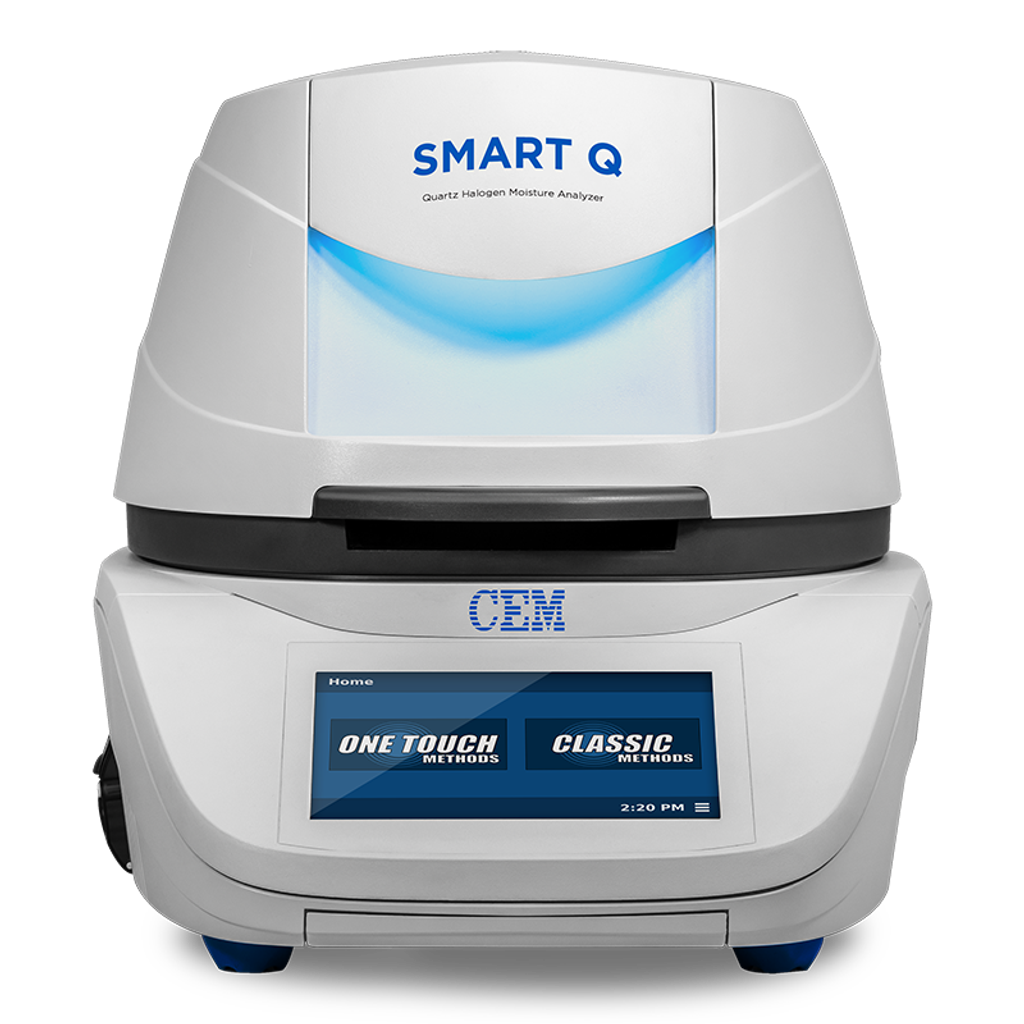
One example is the CEM SMART Q, which CEM describes as a quartz halogen moisture analyzer designed for dry products with up to 15% moisture. It uses an analytical 4-place balance, needs no cavity preheat, and is compact enough for at-line use. CEM lists dairy powders, processed foods, plastics and pharmaceutical products as typical applications.
Microwave and infrared moisture analyzers
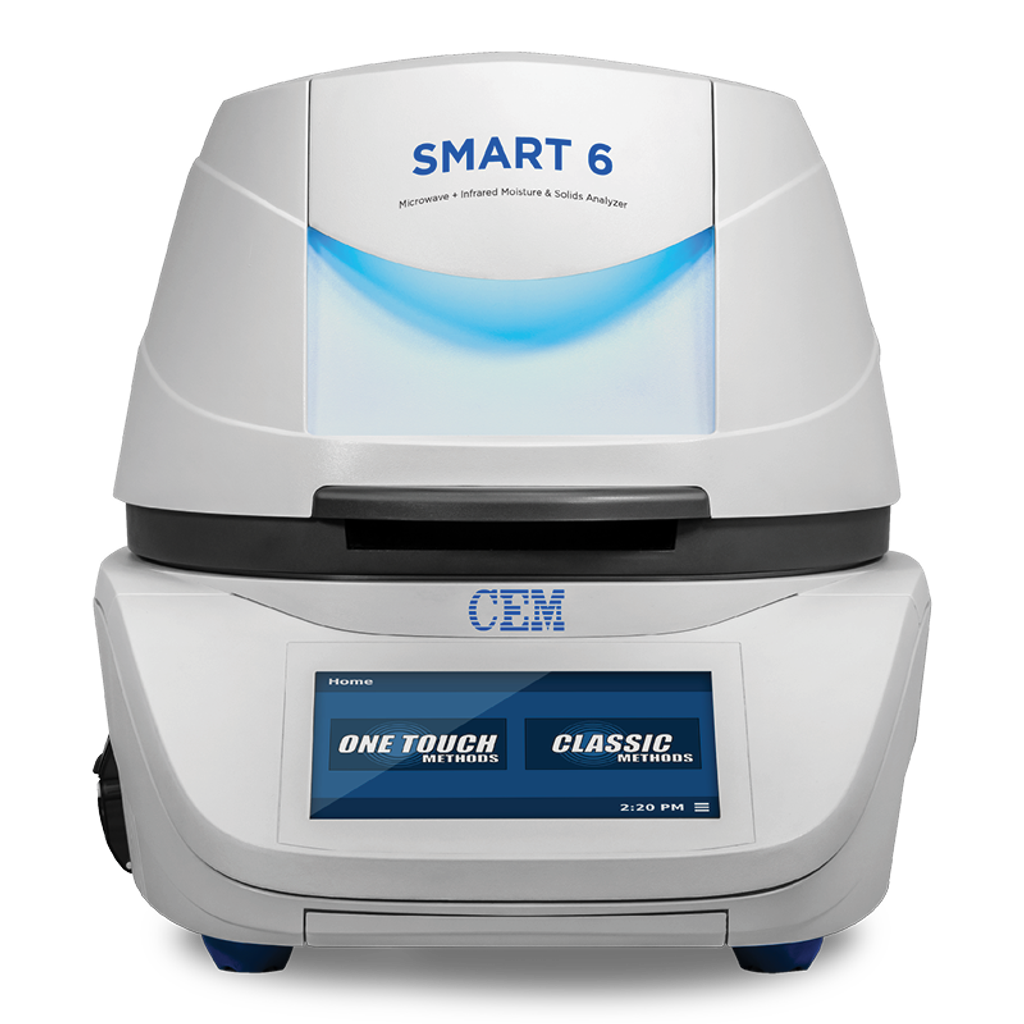
Microwaves deliver energy directly to water molecules, so drying is fast, and several microwave drying methods are officially recognized, provided the energy is applied evenly across the sample. The CEM SMART 6 combines microwave (lower frequency) and infrared (higher frequency) energy and measures sample temperature directly to prevent burning. CEM states that this dual-frequency drying removes both bound and free moisture, handles wet and dry samples on one system, analyzes moisture in approximately 3 minutes, and meets several AOAC methods, including 985.14, 2008.06 (moisture and fat in meats) and PVM 1:2004 (moisture/solids and fat in dairy products).
In a study CEM published on five meat and dairy alternative products, the average SMART 6 moisture result was within 0.04 percentage points of the 100 °C, 8-hour air oven for every sample, for example 84.49% versus 84.45% for rice milk. The full data are in CEM’s application note Moisture, Fat, and Protein Analysis for Meat and Dairy Alternatives.
Karl Fischer titration: water and nothing else
Karl Fischer determines water content through the reaction of water with iodine and sulfur dioxide (2H₂O + SO₂ + I₂ → H₂SO₄ + 2HI); some methods use an oven to help release water from the sample before the titration. The sample is titrated until all the water has reacted, and the water content is calculated from the reagent consumed. Following the end point electrically rather than by eye improves precision, and automated instruments are available.
Its strength is specificity: the reagent reacts with water, so other volatiles are not counted as moisture. That makes it a good fit for low-moisture samples, sugar-rich samples that change when heated, and samples containing volatiles such as spices, herbs, coffee, oils and fats. The conditions are that the reagent must reach all the water in the sample without reacting with anything else, and the lab must handle the chemicals involved.
Moisture content vs water activity: what is the difference?
Moisture content tells you how much water there is. Water activity (aw) tells you how available that water is to take part in reactions or support microbial growth. Researchers treat the two as complementary measurements, not substitutes for each other.
Water activity is the ratio of the vapor pressure of water above a sample at equilibrium to that of pure water under the same conditions. An aw of 0.80 means the vapor pressure is 80% of that of pure water, and aw equals the equilibrium relative humidity (ERH) divided by 100. Because bound water is far less volatile than free water, aw is a good indicator of how much free water is present.
Temperature matters when measuring it: water activity changes with temperature, and the direction and size of the change depend on the product. The U.S. FDA notes that a 1 °C difference between the sample surface and the air above it can shift the reading by 0.05, so an aw instrument needs good temperature control.
In Thailand, aw is a number the law actually uses. Notification of the Ministry of Public Health (No. 469) B.E. 2569 (2026) on food in hermetically sealed containers, published in the Royal Gazette on 18 May 2026 and repealing No. 355 B.E. 2556 (2013), defines low-acid food as food with a pH above 4.6 and a water activity above 0.85. That classification depends on a measured aw; percent moisture cannot stand in for it.
Conversely, controlling formulations, net weight and nutrition-label calculations calls for percent moisture. Products that face both questions should measure both values.
Where do moisture errors come from?
Most errors in moisture analysis are not caused by carelessness. They come from choosing an analysis method and analysis time that do not suit the type and condition of the sample. Food analysis references flag the following pitfalls for drying methods.
- Sample size and thickness: the finer the grind and the thinner the layer, the larger the surface area and the faster water leaves. Samples that clump or form a surface crust trap water inside, giving low and irreproducible results. Mixing with pre-dried sand is a common fix.
- Too hot or too long: heat-sensitive components decompose. Carbohydrates that break down release extra water and inflate the moisture result, while some reactions, such as sucrose hydrolysis, consume water and push it lower.
- Too cool or too short: bound water is not fully removed, and dissolved solutes such as salts and sugars raise the boiling point of water, so it leaves more slowly than expected.
- Volatiles other than water: drying methods count everything that evaporates as moisture. In most foods the other volatiles are small enough to ignore, but spices and herbs call for another method, such as distillation or Karl Fischer.
- Spattering in high-moisture samples: samples such as milk can boil over and carry solids with them, so most of the water should be removed first, with final drying as a second stage.
- Sample and pan handling: samples left open gain or lose water to the surrounding air, and storage containers should be filled to the top to minimize headspace. Aluminium pans should be dried and kept in a desiccator before use, and handled with tongs, since fingerprints add weight. In a humid lab, this step deserves extra care.
Moisture analyzers add one more setting to get right: the end point. Stop too early and bound water remains; dry too long or too hot and you are back to decomposition. A good method sets temperature and end-point criteria for each sample type and confirms that results match the reference method before routine use.
How to choose a moisture analysis method and moisture analyzer
The table summarizes what each method measures, where it is strong, and what to watch for.
| Method | What it measures | Strengths | Watch for | Best suited to |
|---|---|---|---|---|
| Oven drying | Weight lost during drying, including other volatiles | Basis of many official methods; many samples at once; vacuum ovens allow lower temperatures | Takes hours; temperature varies with position in the oven; samples must cool in a desiccator before weighing | Reference testing, confirmation, and validating methods on faster instruments |
| Halogen / infrared moisture analyzer | Weight lost during drying, read continuously by a built-in balance | Fast, easy to use, suitable for at-line use | Results depend on sample size, thickness and position; method must be matched to the reference | Dry products such as powders and granules that need results on the line |
| Microwave + infrared moisture analyzer | Weight lost during drying | Rapid heating; wet and dry samples on one system; meets several AOAC methods | Sample temperature must be controlled to avoid burning, and energy must reach the whole sample | Samples across a wide moisture range, such as meat and dairy products |
| Karl Fischer titration | Water only, by chemical reaction with iodine | Specific to water; measured by chemical reaction; other volatiles not counted | Uses chemical reagents, which must reach all the water in the sample | Low-moisture, sugar-rich or volatile-containing samples such as spices, coffee and oils |
| Water activity meter | Vapor pressure of water relative to pure water, not the amount of water | A more direct indicator of microbial risk and stability than percent moisture | Reading changes with temperature, which must be controlled during measurement | Food safety, shelf life, and food classification under Thai MOPH Notification No. 469 |
Then answer four questions before choosing an instrument:
- Which method do your customers, standards or regulations name as the reference? Any rapid instrument has to be set up to match it.
- Do you need total water, or how available the water is to microbes? The latter is water activity.
- Are your samples wet or dry, high in sugar, or do they contain volatiles other than water? An instrument such as the SMART 6 can analyze high-sugar samples and measures the weight of volatiles lost during drying. If you need the water content alone, Karl Fischer may be required.
- How many samples per shift, and where will you test: in the lab or next to the line?
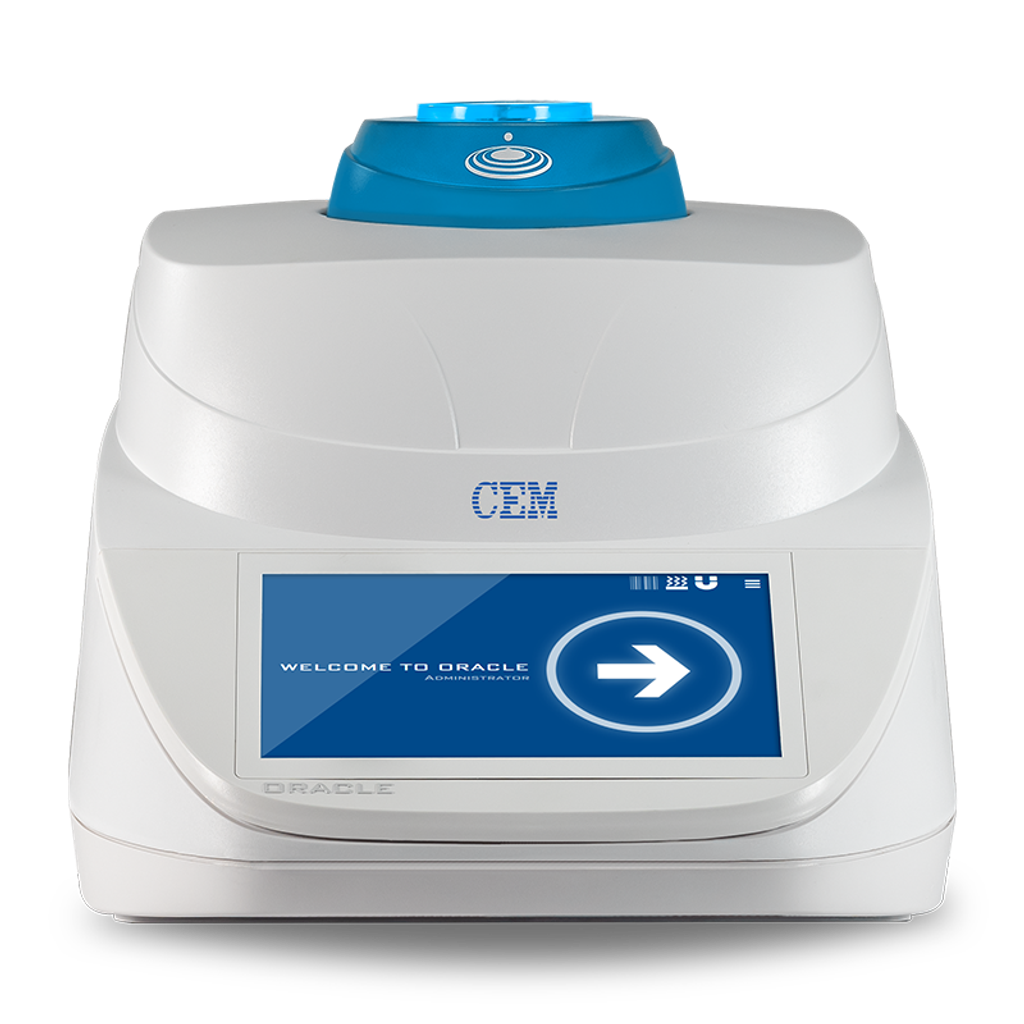
Among the CEM moisture analyzers that Thai Unique supports, the SMART Q suits dry products with up to 15% moisture that need results at the line. The SMART 6 covers everything from dry to wet samples on one system, with more than 200 existing methods, and when fat is also needed it pairs with the ORACLE to deliver moisture and fat in less than five minutes.
Testing your own samples and after-sales support in Thailand
If you are looking for a moisture analysis solution that suits your production line, we are ready to advise you specifically on the method. Whether a rapid instrument will match your oven depends on your own samples, not on brochure figures, so Thai Unique offers Sample Testing & Method Verification against the reference method you already use, before you decide.
After installation, our application chemists in Thailand help trace why a result differs from the reference, whether the cause is temperature, end point or sample preparation. On repairs, more than 95% of cases are closed in Thailand, and around 5% are sent back to the manufacturer’s factory. Calibration, scheduled maintenance and hands-on training on your own instrument are part of the same support.
Thai Unique Co., Ltd. is the official distributor of CEM in Thailand, with an in-country after-sales service team · 0-2629-0191-6 · customer.service@thaiunique.com · Request a quote
Frequently asked questions
Moisture analyzer vs oven drying: what is the difference?
It is a balance with a built-in heat source. It uses the same loss-on-drying principle as an oven, but an oven takes hours and handles many samples at once, while a moisture analyzer gives one result at a time in minutes.
Which samples suit a halogen moisture analyzer?
Dry samples that can be spread in a thin, even layer, such as powders and granules, because infrared heating repeats well when sample thickness is constant. For very moist or uneven samples, compare against the reference method before routine use.
Moisture analyzer vs Karl Fischer: can one replace the other?
In some cases. If a sample has almost no other volatiles and does not decompose when heated, loss on drying comes close to the true water content. For very low moisture, high sugar or essential oils, Karl Fischer gives a more water-specific result. The safest route is to compare both methods on your real samples.
Moisture analyzer vs water activity: are they interchangeable?
No. Percent moisture is the total amount of water, while water activity is a vapor-pressure ratio that shows how available the water is to microbes. Two products with the same moisture can therefore have different aw if their balance of free and bound water differs (see USDA, Water Activity in Food).
Can bound water be measured separately?
Yes, with specialized techniques such as NMR, thermogravimetry and DSC, which rely on differences between bound and free water in molecular mobility, evaporation temperature or melting temperature. Routine moisture analyzers report a single total value.
Sources:
- McClements DJ. Determination of Moisture and Total Solids. Food Analysis lecture notes (FD SCI 581), University of Massachusetts Amherst. people.umass.edu/~mcclemen/581Moisture.html
- U.S. FDA. Water Activity (aw) in Foods. Inspection Technical Guide No. 39. fda.gov
- USDA ARS. Pathogen Modeling Program Online: Water Activity in Food (Division of Food Science and Technology Fact Sheet, CSIRO, August 1995). pmp.ars.usda.gov
- FAO. Food energy – methods of analysis and conversion factors. FAO Food and Nutrition Paper 77 (2003), Chapter 2. fao.org
- Achata E, Esquerre C, O’Donnell C, Gowen A. A Study on the Application of Near Infrared Hyperspectral Chemical Imaging for Monitoring Moisture Content and Water Activity in Low Moisture Systems. Molecules 20, 2611 (2015). doi:10.3390/molecules20022611
- Notification of the Ministry of Public Health (No. 469) B.E. 2569 (2026) Re: Food in Hermetically Sealed Containers. Royal Gazette Vol. 143, Special Part 123 D, 18 May 2026 (in Thai). food.fda.moph.go.th
- CEM. Moisture, Fat, and Protein Analysis for Meat and Dairy Alternatives. Application Note ap0194. cem.com